From Internal Collision to Photon Escape: First-Principles Modeling of Radiation-Mediated Shocks in Gamma-Ray Burst Photospheres

From Internal Collision to Photon Escape: First-Principles Modeling of Radiation-Mediated Shocks in Gamma-Ray Burst Photospheres
Jona Nordin Nobuoka, Filip Alamaa, Felix Ryde, Christoffer Lundman
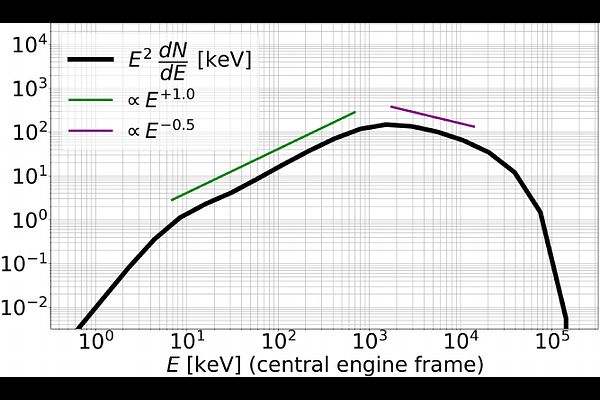
AbstractModeling subphotospheric shocks in a gamma-ray burst (GRB) is challenging due to the various timescales that must be resolved, and the fact that the same radiation dynamically mediates the shocks while forming the observed signal. Here, we present the first self-consistent radiation-hydrodynamic simulation of a subphotospheric internal collision, following the system from formation and propagation of forward and reverse radiation-mediated shocks all the way to photon decoupling and free streaming toward the observer. The simulation evolves the plasma and photon field with full Compton coupling, including the feedback on the hydrodynamic flow. As the ejecta expands and the optical depth decreases, both shocks broaden and the radiation field becomes highly non-thermal. Surprisingly, we find that the reverse shock remains completely radiation-mediated down to upstream optical depths of order a few $\times 10^{-1}$, which indicates that Compton coupling is important even in moderately optically thin regions. The photons undergo last scattering over a broad range of radii rather than at a single photospheric surface. The light curve shows a late, quasi-thermal post-cursor produced by photons that decouple upstream of the reverse shock, which could be searched for in observations. The emitted time-integrated spectrum is GRB-like, with a low-energy photon index $α\sim -1$ and a high-energy photon index $β\sim -2.5$. These results show how radiation-mediated shocks evolve close to the photosphere and how they shape the emitted photon field.