The CepA disk-outflow system at <=0.2'' or <=100au resolution

The CepA disk-outflow system at <=0.2'' or <=100au resolution
H. Beuther, C. Gieser, V. Aberham, J. M. Winters, R. Neri, A. Ahmadi, R. Kuiper, Th. Henning, H. Linz, T. Möller, V. Elbakyan, L. Moscadelli, D. Semenov, J. Urquhart, P. Klaassen, M. Beltran, Á. Sánchez-Monge, T. Peters, R. Galvan-Madrid, S. Leurini, S. Lumsden, R. E. Pudritz, A. Palau, H. Zinnecker
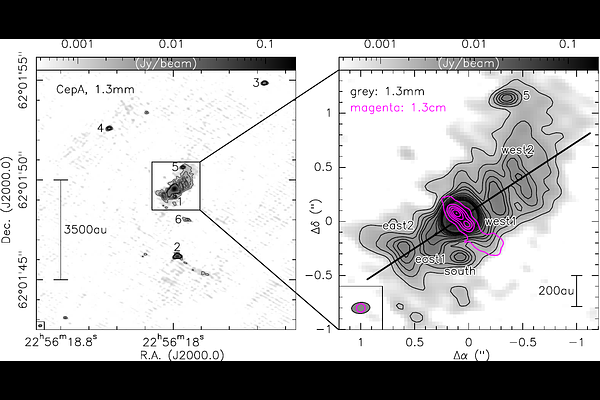
AbstractContext: Although there has been significant progress, the physical properties and potential fragmentation of accretion disks around high-mass protostars remain poorly constrained. Aims: We characterize at high angular resolution one of the most nearby (~700pc) high-mass accretion disk candidates CepA HW2. Methods: Using the new long baseline array configuration (~1700m) of the Northern Extended Millimeter Array (NOEMA), we study CepA HW2 with a resolution of <=0.2'' or <=100au at 1.3mm in dust continuum and spectral line emission. Results: The mm continuum emission resolves the central disk candidate into several sub-structures. Conducting a Toomre Q stability analysis based on CH_3CN and continuum data, and a comparison to 3D radiation hydrodynamic simulations shows that the data are consistent with an almost edge-on disk where the observed sub-structures may represent fragments within the disk. The CO and SiO spectral line data confirm a second bipolar outflow (in addition to the well-known jet) emanating from the central peak position. This indicates that this central peak should host at least a binary if not even a higher order multiple system. The usually assumed dense gas tracer CH_3CN shows also contributions from the outflows which complicates further kinematic analysis of the disk. Conclusions: The high-resolution outflow-disk data of CepA reveal a multiply fragmented disk that drives several outflows. These observations enforce the picture of high-mass star formation where multiplicity and fragmentation can happen on the smallest spatial scales related to the inner accretion disks.