The Milky Way Atlas for Linear Filaments III: Giant filaments and magnetic fields as evidence of a bubbly Galactic disk

The Milky Way Atlas for Linear Filaments III: Giant filaments and magnetic fields as evidence of a bubbly Galactic disk
Naval K. Bhadari, Ke Wang, Shu-ichiro Inutsuka, Mingke Sun
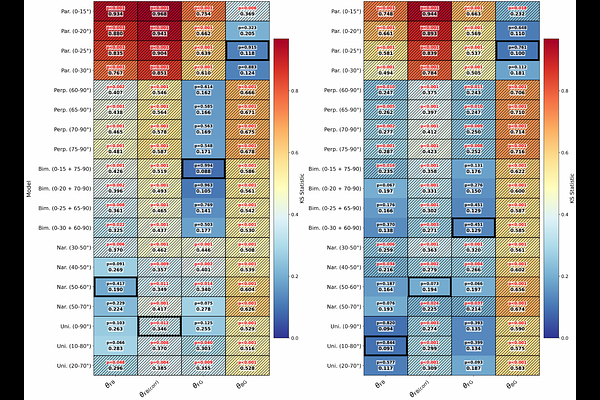
AbstractLinear filamentary structures are fundamental constituents of the interstellar medium and play a central role in star formation. Their relative orientation with respect to the ambient magnetic field (B-field) provides key constraints on filament formation mechanisms. We investigate the relative orientation between Milky Way linear filaments (MWLFs) and the plane-of-sky B-field using polarization observations from the Atacama Cosmology Telescope (ACT) DR6, complemented by Planck data. Filament orientations are compared with the local B-field and the Galactic plane, while projection effects and statistical significance are quantified using Monte Carlo simulations of vector pairs in three-dimensions. We find no strong preferential alignment between MWLFs and the ambient B-field. Although the B-field is preferentially aligned with the Galactic plane with relative angles $θ_{\rm BG} \sim0-25°$, filament orientations exhibit a bimodal distribution, being either parallel or perpendicular to the plane ($θ_{\rm FG} \sim0-15°$ and $\sim75-90°$). Filaments located far from the Galactic midplane ($|z|>90$ pc) preferentially show perpendicular alignment with both the plane and the B-field, whereas those near the midplane exhibit a bimodal orientation. These results indicate that large-scale B-fields do not dominate the formation of MWLFs and instead favor a super-Alfvénic regime in which magnetic forces are dynamically subdominant, as expected for filaments associated with supernova-driven shells. Overall, our findings suggest that a face-on view of the Milky Way would resemble nearby disk galaxies such as M74, as observed in JWST images, with its disk structured by a network of supernova-driven bubbles (i.e., a bubbly disk).