JWST spectroscopy of galaxies at $z>10$: Damped Ly$α$ absorbers reveal efficient star formation and hidden redshift biases

JWST spectroscopy of galaxies at $z>10$: Damped Ly$α$ absorbers reveal efficient star formation and hidden redshift biases
Kasper E. Heintz, Clara L. Pollock, Joris Witstok, Rychard J. Bouwens, Sandro Tacchella, Pascal A. Oesch. Pratika Dayal, Sownak Bose, Gabriel B. Brammer, Johan P. U. Fynbo, Rashmi Gottumukkala, Matthew J. Hayes, Akio K. Inoue, Benjamin Johnson, Harley Katz, Peter Laursen, Rohan P. Naidu, Desika Narayanan, Lucie E. Rowland, Nial R. Tanvir, Chamilla Terp, Sune Toft, Francesco Valentino, Fabian Walter, John R. Weaver, Arjen van der Wel, Mengyuan Xiao
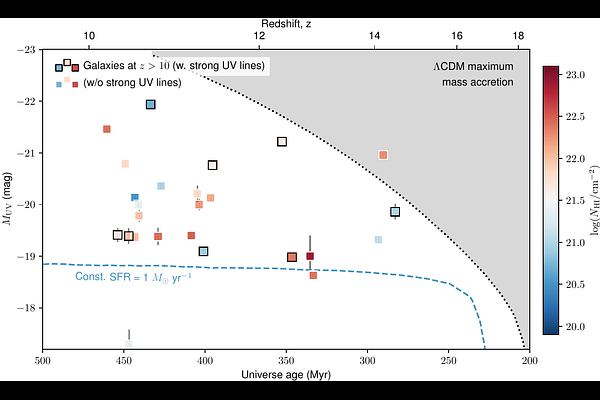
AbstractRecent observations with JWST have revealed a remarkable population of surprisingly luminous galaxies at redshifts $z>10$. Their abundance exceed predictions from simulations and empirical extrapolations from lower redshifts, suggesting a transition in the physical conditions under which the first stars formed. Here we investigate the physical conditions of a select sample of 25 galaxies with robust redshift measurements at $z_{\rm spec}\geq 10$ observed with JWST/NIRSpec Prism. We characterize their star-formation efficiency, `burstiness', and presence of strong rest-frame UV nebular lines in relation to the density of the local neutral atomic hydrogen (HI) gas reservoirs they are embedded in. We find that the prominence of strong rest-UV lines are correlated with the burstiness of the galaxies, defined as ${\rm SFR_{10\,Myr} / SFR_{100\,Myr}}$. In contrast, there are no strong connections between the HI gas column density derived from the damped Ly$α$ absorption (DLA) and the $M_{\rm UV}$ brightness, ${\rm SFR_{10\,Myr} / SFR_{100\,Myr}}$, and prominence of rest-UV lines. The most bursty galaxies show a large variation in star-formation efficiencies and HI gas surface densities, though typically with very short depletion timescales, $t_{\rm dep} \lesssim 20$\,Myr. This necessites rapid gas depletion times and external replenishment from infalling, pristine gas, powering starburst episodes on equally short timescales. We further quantify the impact of strong DLAs in galaxy spectra on photometric and Ly$α$-break redshift-inferences, finding average redshift biases of $\langle z \rangle =0.39$ and $0.14$, respectively, when not incorporating DLAs on the emergent spectra. We show the effect of this bias on new measurements of the cosmic UV luminosity density, $ρ_{\rm UV}$, derived here at $z>10$, finding that this has a marginal impact on the UV luminosity function.