The effects of bar strength and kinematics on galaxy evolution II: The global and local impacts of slow-strong bars

The effects of bar strength and kinematics on galaxy evolution II: The global and local impacts of slow-strong bars
Petra Mengistu, Karen L. Masters, Tobias Geron, R. J. Smethurst, Chris Lintott, B. D. Simmons
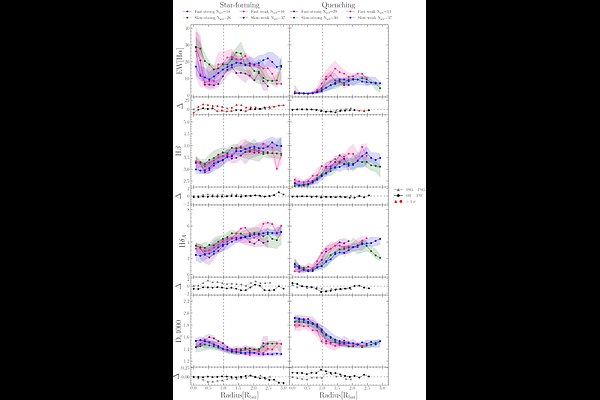
AbstractThere is now clear evidence, from a variety of studies, that galactic bars contribute to and/or accelerate processes which quench galaxies. However, bars have a variety of strengths and pattern speeds, and previous work has suggested that slow and strong bars impact their hosts the most. In this paper, we continue to investigate the impact of bar strength and bar speed on host galaxy evolution in a sample of barred galaxies identified via classifications from Galaxy Zoo. We perform a comprehensive assessment of star-formation tracers spanning a variety of timescales, based on spatially resolved spectroscopic information from the Mapping Nearby Galaxies at Apache Point Observatory (MaNGA) survey. Specifically, we examine the radial distributions of EW[Halpha], HdeltaA, Hbeta, and Dn4000; spectral data that trace star-formation on current, intermediate, and much longer timescales. We investigate how these star-formation tracers vary with respect to each other in diagnostic evolutionary planes for eight categories of barred galaxies (combinations of star forming or quenching; strong and weak; fast and slow). We continue to find that slow-strong bars drive the quenching of their hosts the most by triggering active star-formation throughout the barred region; however, we note some additional complexity: we observe that stronger bars boost star-formation at the bar centre while slower bars have increased star-formation along the bar. This work adds to the growing evidence that galactic bars have both global and local impacts on their host galaxies.