Chemo-dynamical reconstruction of Milky Way globular cluster progenitors: age--metallicity relations and the universality of multiple stellar populations

Chemo-dynamical reconstruction of Milky Way globular cluster progenitors: age--metallicity relations and the universality of multiple stellar populations
Carmela Lardo, David Valcin, Raul Jimenez
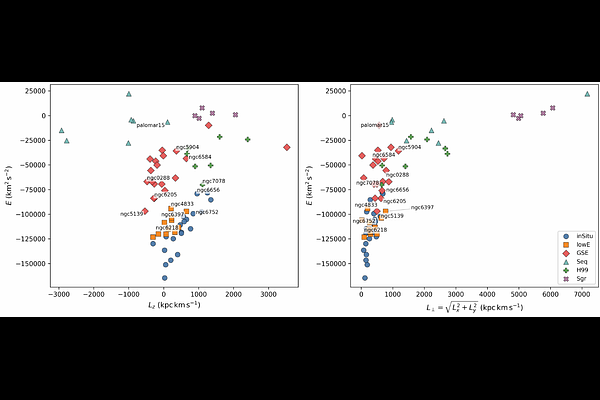
AbstractGlobular clusters encode the hierarchical assembly history of the Milky Way and the physics of multiple stellar populations. Using homogeneous stellar parameters for 69 Galactic globular clusters derived while modelling multiple populations, we reconstruct progenitor-specific age--metallicity relations (AMRs) and test whether helium-related multiple-population (MP) properties depend on progenitor origin once cluster mass and metallicity are controlled for. Ages, helium spreads ($δY$), mean helium abundances ($\bar{Y}$), and first-population fractions ($f_{\rm P1}$) are drawn from hierarchical Bayesian CMD modelling. Progenitor families are identified via chemo-dynamical clustering, AMRs reconstructed within a hierarchical Bayesian framework, and MP indicators tested for environmental dependence. Enrichment timescales are consistent with $τ\lesssim 2$\,Gyr, though individual progenitors prefer shorter values when fitted independently. The primary distinction is the extent of chemical evolution: most systems reach $Δ[\mathrm{Fe/H}] \sim 1.1$--$1.3$\,dex while Sagittarius achieves ${\sim}1.6$\,dex and higher terminal metallicities. Gaia--Sausage--Enceladus and low-energy/Kraken are the dominant accretion events. Neither $δY$ nor $\bar{Y}$ depends on progenitor origin; the mass--MP scaling is indistinguishable across in-situ and accreted systems. Sequoia clusters alone show higher $f_{\rm P1}$ at fixed mass and metallicity. AMRs carry fossil signatures of progenitor chemical evolution and mass hierarchy. Helium enrichment amplitude is regulated by cluster mass and blind to environment, pointing to universal cluster-scale formation physics, with the sole exception of a residual dependence in $f_{\rm P1}$, suggesting the enriched-star fraction retains a secondary environmental imprint.