Constraining the Leptonic and Hadronic Contributions to the Gamma-Ray Emission of SNR HESS J1731-347 with CTAO Forecasts

Constraining the Leptonic and Hadronic Contributions to the Gamma-Ray Emission of SNR HESS J1731-347 with CTAO Forecasts
D. B. Götz, M. F. Sousa, R. C. Anjos
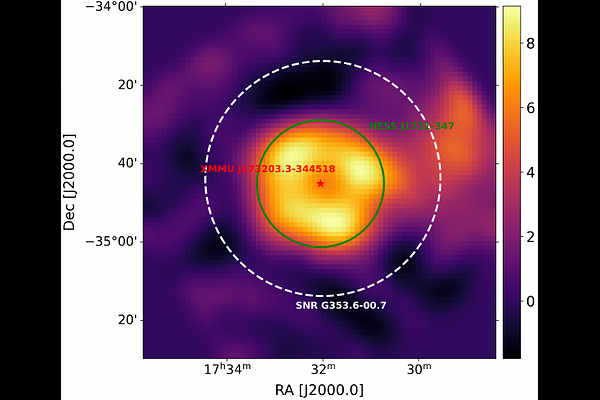
AbstractWe present a Bayesian broadband spectral analysis of the supernova remnant HESS J1731-347, combining archival radio, X-ray, and H.E.S.S. data with a new analysis of 16 yr of Fermi-LAT observations. The LAT data allow the GeV emission of the western molecular-cloud core (MC-core) to be separated from that of the remaining shell. We fit purely leptonic and lepto-hadronic models with and without the MC-core region. Within a one-zone model with fixed distance and ambient density, the lepto-hadronic scenario is strongly preferred by the Bayesian Information Criterion (BIC) in both cases. Excluding the MC-core, we obtain $Δ{\rm BIC}=33.67$, a magnetic field of $B = 84.9^{+27.5}_{-22.9}$ $μ$G, a hard proton index of $α_p = 1.69 \pm 0.10$, and a proton energy of $W_p = (4.37^{+0.64}_{-0.51})\times10^{48}$ erg for $n_{\rm H}=20$ cm$^{-3}$. The preference for a hadronic contribution is therefore not driven by the MC-core emission alone. CTAO simulations show that a 50 h observation with the southern array would detect the source at $13σ$ to $18σ$ and substantially improve the constraints on its TeV spectrum.