Gas Giants Formed by Gravitational Instability May Accrete Atmospheres with Super-Stellar Carbon to Oxygen Ratios

Gas Giants Formed by Gravitational Instability May Accrete Atmospheres with Super-Stellar Carbon to Oxygen Ratios
Alan P. Boss
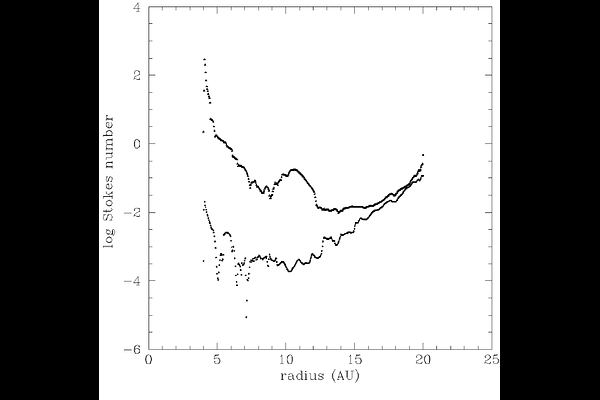
AbstractCharacterizing the atmospheric compositions of exoplanets, along with determining properties such as their mass, mean density, and orbital configuration, is thought to be an effective means for differentiating between various formation and evolution scenarios. Exoplanet atmospheric C/O ratios, when compared to host star C/O ratios, have been advanced as discriminators of gas giant formation and evolution scenarios in the context of the core accretion mechanism. Gas giants formed by gas disk gravitational instability (GDGI), on the other hand, are thought to have atmospheres with C/O ratios identical to their host stars. We examine this assumption through analysis of fully three dimensional radiative hydrodynamics models of the GDGI in the flux-limited diffusion approximation. We show here that GDGI protoplanets may be able to form and accrete disk gas with super-stellar C/O ratios, as a result of their formation and orbital evolution in a disk with midplane temperatures in the range of the evaporation temperatures of water ($\sim$ 135 K) and CO$_2$ ($\sim$ 47 K) ices. Solids that avoid fragmentation and grow rapidly to cm-size could be transported inward to the central protostar or outward to the edge of the disk considerably faster than the disk gas is dissipated, leading to the preferential accretion of C-rich disk gas compared to the O-rich ices, provided that the protoplanet's orbit remains outside $\sim$ 7 au from a solar-mass protostar. Orbits inside $\sim$ 7 au, however, could result in the accretion of disk gas with nearly stellar C/O.