A Bayesian Approach to Prioritizing the Follow-Up of Near-Earth Objects

A Bayesian Approach to Prioritizing the Follow-Up of Near-Earth Objects
Devanshi Singh, Mario Jurić, Željko Ivezić
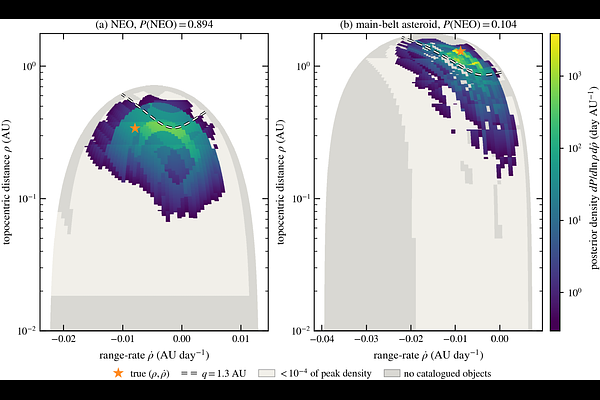
AbstractWe present pneo, a Bayesian classifier that computes the probability that a single-night tracklet belongs to a near-Earth object (NEO), using only its sky position, angular motion, and apparent magnitude. A tracklet does not determine the object's distance or radial velocity, so pneo integrates a model of the Solar System's small-body populations over all bound orbits consistent with it. The result is the exact posterior probability under that model, with no tuned scores or separately chosen priors: its classifications are optimal for the adopted model, and its probabilities are calibrated. On real discovery tracklets from the NEO Confirmation Page, the classifier is well calibrated and its selection is 1.14 times purer than that of digest2, the classifier now in use, at the same completeness. The advantage grows at Rubin's depth, where the faint background of main-belt and more distant objects is still largely undiscovered. On simulated tracklets to that depth, its selection is 2 times purer than that of digest2 (96% against 48%). On the Rubin alert stream and Rubin Data Preview 2 its selection is 1.4-1.7 times purer than that of digest2, and its predicted NEO counts are close to those observed. By raising the fraction of follow-up targets that are NEOs, pneo could potentially double the effective capacity of NEO follow-up in the Rubin era.