Multi-Messenger and Cosmological Constraints on Dark Matter through Two-Fluid Neutron Star Modeling

Multi-Messenger and Cosmological Constraints on Dark Matter through Two-Fluid Neutron Star Modeling
Ankit Kumar, Sudhakantha Girmohanta, Hajime Sotani
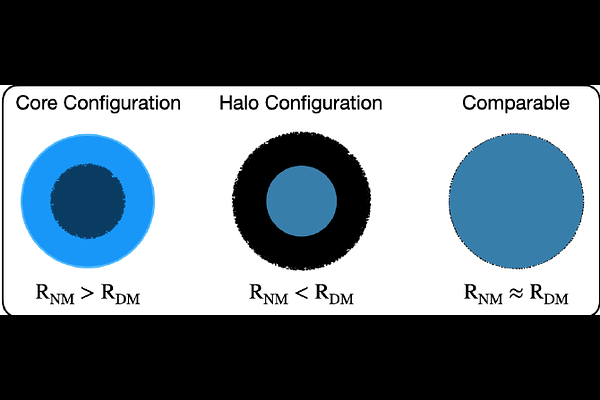
AbstractIn this study, we investigate the impact of dark matter (DM) on neutron stars (NSs) using a two-fluid formalism that treats nuclear matter (NM) and DM as gravitationally coupled components. Employing NM equations of state spanning a wide range of stiffness and a self-interacting asymmetric fermionic DM framework, we explore the emergence of DM core- and halo-dominated structures and their observational implications. Constraints from gravitational waves (GW170817), NICER X-ray measurements (PSR J0030+0451), and pulsar mass limits (PSR J0740+6620) delineate a consistent parameter space for DM properties derived from these multi-messenger observations. DM halo-dominated configurations, while consistent with PSR J0740+6620's mass limits and NICER's radius measurements for PSR J0030+0451, are ruled out by the tidal deformability bounds inferred from the GW170817 event. Consequently, the combined limits inferred from the observational data of GW170817, PSR J0030+0451, and PSR J0740+6620 support the plausibility of DM core-dominated configurations. Constraints on the DM self-interaction strength from galaxy cluster dynamics further refine the DM parameter space permitted by NS observations. This work bridges multi-messenger astrophysics and cosmology, providing insights into DM interactions and their implications for NS structure, evolution, and observational signatures.