Self-lensing of moving gravitational-wave sources can break the microlensing crossing timescale degeneracy

Self-lensing of moving gravitational-wave sources can break the microlensing crossing timescale degeneracy
Helena Ubach
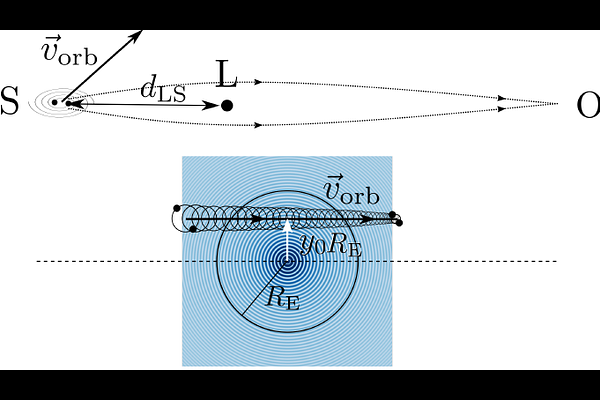
AbstractWhen a moving gravitational-wave (GW) source travels behind a massive astrophysical object, its signal is gravitationally lensed, showing a waveform distortion similar to a Paczyński curve. We present a first study of the lensing signature of a massive black hole (MBH) on a frequency-dependent GW signal from a moving binary merger. For both light and GW sources in a Keplerian circular orbit around a MBH lens, the self-lensing geometry breaks the microlensing degeneracy in the Einstein radius crossing timescale $t_{\rm E}$. The duration of the curve ($2 t_{\rm E}$) becomes independent on the MBH mass $M_{\rm MBH}$, and provides a direct measure of the distance $d_{\rm LS}$ to the MBH. However, $M_{\rm MBH}$ remains unknown. We show that, in GW signals, the redshifted mass $M_{{\rm MBH},z}$ can additionally be obtained from the interference pattern, by measuring the modulation period $T$, the GW frequency $f$, and $t_{\rm E}$: $M_{{\rm MBH},z}\simeq 2.5\times 10^6\,M_\odot\,(t_{\rm E}/[100\,{\rm s}])\,(f\,T)^{-1}$. If this lensing signature is not considered, it may be confused with other waveform distortions, especially in the modeling of overlapping signals in next generation ground-based GW detectors. The observation of one of these curves and its associated parameters may help (1) constrain the orbital distance $d_{\rm LS}$ of sources, especially around low mass MBHs at the centers of star clusters and galaxies, (2) additionally estimate the mass $M_{{\rm MBH},z}$ of these MBHs, and (3) infer the orbital inclination of the binary. Simultaneously obtaining $d_{\rm LS}$ and $M_{{\rm MBH},z}$ through self-lensing can help constrain the astrophysical environments where GW signals come from.