Assessing Ultra-Cool Dwarf Contamination in Photometrically Selected High-Redshift Galaxy Samples

Assessing Ultra-Cool Dwarf Contamination in Photometrically Selected High-Redshift Galaxy Samples
Onnalin Innala, Nicha Leethochawalit, Takahiro Morishita, Michele Trenti
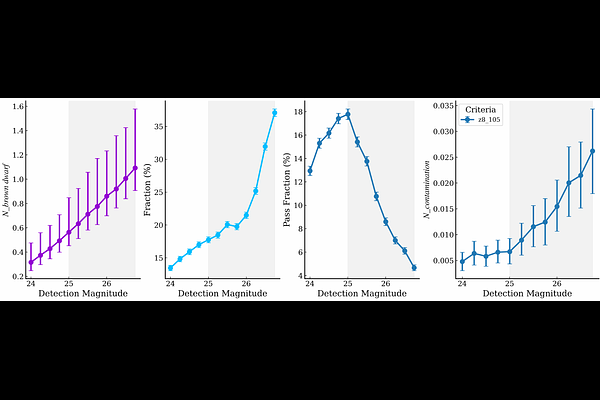
AbstractUltra-cool dwarf stars (UCDs) are a common source of contamination in high-redshift galaxy searches as both sources are red and these early-forming galaxies can have sizes that are difficult to resolve even with space telescopes. Standard selection techniques, including photometric redshift estimation and color-color criteria, cannot fully eliminate this contamination. We develop \textbf{F}oreground \textbf{C}ontamination \textbf{E}valuator of \textbf{N}earby dwarf stars in high-\textbf{Z} photometrically selected \textbf{O}bjects (FC-ENZO), a code that predicts the number of dwarf stars misidentified as high-redshift galaxies for a given survey setup. FC-ENZO models the number of UCDs and evaluates the fraction of synthesized dwarf stars that passes user-specified selection methods. We compare two synthetic spectral energy distribution libraries and find that the ELF OWL library, which relaxes the assumption of chemical equilibrium, predicts larger contaminant fractions than the BOBCAT library, because of stronger absorption features around $ 1 $ \micron. The contamination fraction increases with metallicity and also depends on the adopted stellar number-density model. The dominant contaminants are T to early Y-type UCDs, which are most commonly misclassified as galaxies at $z \sim 8$. Comparing deep surveys from different space telescopes, we find similar overall contamination levels within the same redshift range. However, the contamination is concentrated near the limiting magnitude of each survey. At brighter magnitudes, the relative contamination is highest for HST (COSMOS), followed by Roman deep-tier survey, and JWST. Although the predicted contaminant numbers remain sensitive to model assumptions, FC-ENZO provides a practical tool for survey design and for identifying optimal fields for spectroscopic follow-up.