The End of the First Act: Spectral Running, Interacting Dark Radiation, and the Hubble Tension in Light of ACT DR6 Data

The End of the First Act: Spectral Running, Interacting Dark Radiation, and the Hubble Tension in Light of ACT DR6 Data
Mathias Garny, Florian Niedermann, Martin S. Sloth
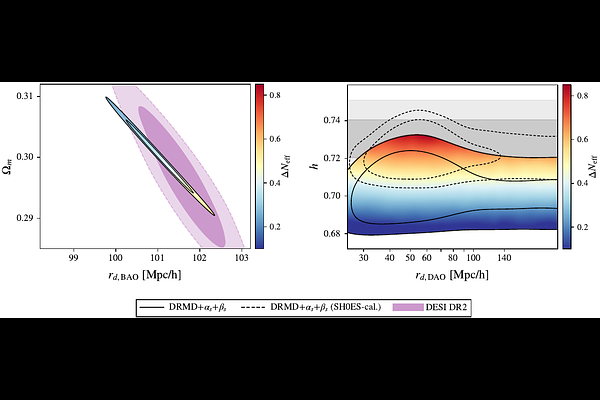
AbstractWe point out that constraints on $ΔN_\mathrm{eff}$ reported by the ACT collaboration in their DR6 data release are surprisingly sensitive to the assumptions made about the initial power spectrum from inflation. The ACT collaboration reports no evidence of new light degrees of freedom alongside a low value of the expansion rate, thus confirming the Hubble tension. However, as we show here, when considering self-interacting dark radiation and including running, $α_s$, and running of the running, $β_s$, of the spectral index $n_s$, the picture changes significantly. Confronting this extended model with Planck, ACT DR6, DESI DR2, and uncalibrated Pantheon+ data, we find the significantly relaxed bound $ΔN_\text{eff}< 0.58$ at 95$\%$ CL, together with a $2.9 σ$ ($2.6 σ$) preference for $α_s>0$ ($β_s>0$), while the Hubble tension is reduced to $2.2 σ$ with only three more parameters compared to $Λ$CDM. If the dark radiation fluid is initially coupled to dark matter, and undergoes dark radiation-matter decoupling (DRMD) around matter-radiation equality, predicting dark acoustic oscillations with drag horizon $r_{d,\mathrm{DAO}} \approx 60 \,\mathrm{Mpc}/h$, the bound is further relaxed to $ΔN_\text{eff}< 0.68$ at 95$\%$ CL, reducing the Hubble tension below $2σ$. We also discuss how $α_s$ and $β_s$ could naturally appear in inflationary scenarios, possibly connected to the end of a first act of inflation. In this case dark radiation is mostly probed by scales covered by Planck and DESI, while smaller scales carry information on inflationary dynamics.