The MARTINI Platform (I): Se I-X atomic calculation and expansion opacity for early-stage kilonova spectral analysis

The MARTINI Platform (I): Se I-X atomic calculation and expansion opacity for early-stage kilonova spectral analysis
Matteo Bezmalinovich, Mattia Bulla, Gediminas Gaigalas, Diego Vescovi, Matteo Canzari, Sergio Cristallo
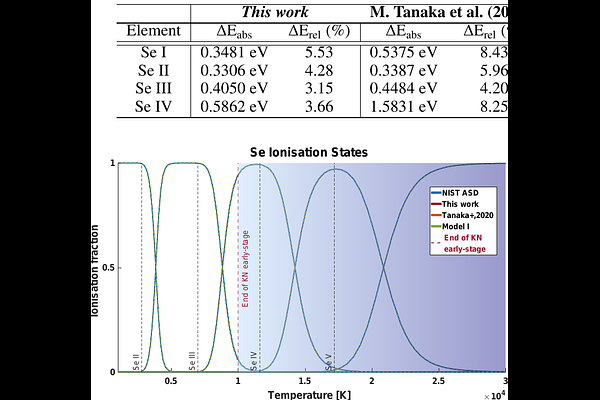
AbstractKilonovae represent key sites of r-process nucleosynthesis, making opacity estimation and spectral analysis crucial for constraining their composition. Since light r-process elements shape the early ($\sim$0.5-1.5$\mathrm{d}$) ejecta opacity, a detailed study of the selenium element with a focus on atomic data calculation, expansion opacity estimation and spectral analysis is presented. Se atomic data are calculated from Se I to Se X using the GRASP2018 code. A systematic analysis and evaluation of their precision is performed through detailed comparison with the NIST ASD, and other works available in the literature. These atomic data are then used to estimate expansion opacity at different temperatures (e.g., T=5000 K, 10000 K, 20000 K, 100000 K) and densities (e.g., $ρ= 10^{-13}\,\mathrm{g\,cm^{-3}},\,3\times10^{-12}\,\mathrm{g\,cm^{-3}}$). Spectral analysis has been performed with radiative transfer code POSSIS with a pre-computed opacity grid calculated with new densities and temperatures, ranging from -19.5 to -4.5 $\mathrm{g\,cm^{-3}}$ in log-scale and from 1 000 to 51 000 K, respectively. Two scenarios are considered: one in which the opacity contribution comes from 100\% Se ejecta, and another in which Se contributes only partially to the total opacity ($\sim$ 10\% of the total mass). Se atomic calculations show a good agreement with NIST ASD, with accurate energy levels and transitions determined alongside atomic data for higher ionisation stages not fully covered by NIST. The expansion opacities calculated with these new Se data exhibit differences in comparison to existing literature works. Se spectral features can only be observed in the KN scenario consisting of 100\% Se. When Se accounts for about 10\% of the total KN mass, these features become undetectable. All Se results are now available in the new open-source MARTINI platform dedicated to element nucleosynthesis.