Shocks from Exploding Primordial Black Holes in the Early Universe

Shocks from Exploding Primordial Black Holes in the Early Universe
Miguel Vanvlasselaer, Sokratis Trifinopoulos, Alexandra P. Klipfel, David I. Kaiser
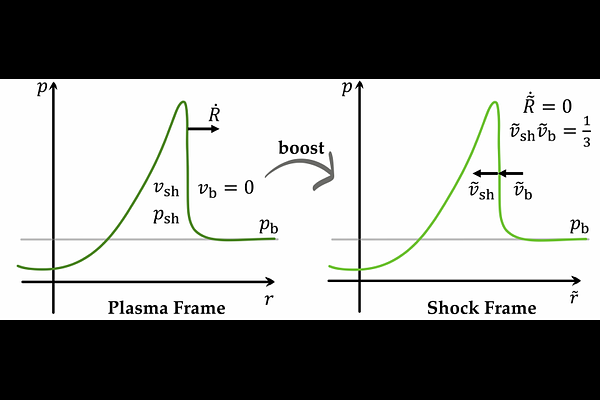
AbstractWe investigate how Hawking radiation from low-mass primordial black holes deposits energy into the early-universe plasma and show that the resulting phenomena are hydrodynamic rather than purely diffusive. Combining analytic arguments with relativistic hydrodynamic simulations, we find that the plasma first develops a quasi-steady outflow during the slow evaporation stage, while the final runaway phase of evaporation produces an expanding fireball that launches a shock wave into the surrounding medium. We characterize the thermalization scale of the Hawking products, the conditions under which shocks form, and the evolution and propagation of shocks. Additionally, we show that these shocks can locally restore electroweak symmetry, identifying exploding PBHs as a potentially important source of out-of-equilibrium dynamics in the early universe with profound phenomenological implications.