Ground-based Atmospheric Characterization of Super-Earth L 98-59 d at High Spectral Resolution

Ground-based Atmospheric Characterization of Super-Earth L 98-59 d at High Spectral Resolution
Connor J. Cheverall, Nikku Madhusudhan, Savvas Constantinou, Peter R. McCullough
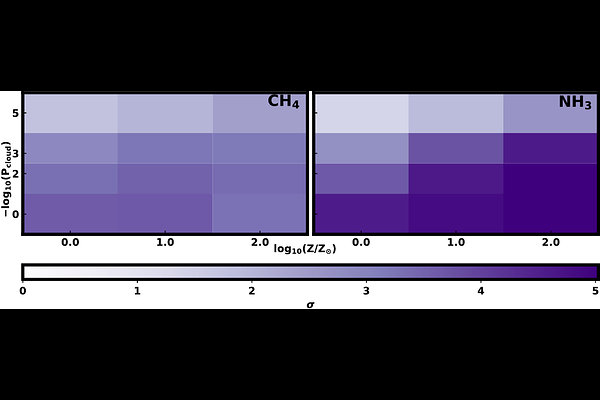
AbstractAtmospheric characterization of exoplanets using ground-based high-resolution transmission spectroscopy has traditionally focussed on large and close-in planets, such as hot Jupiters. In this work, we aim to extend this technique to smaller and more temperate planets by studying the atmospheric composition of the temperate super-Earth planet L 98-59 d ($\sim$$1.5\,\mathrm{R_{\oplus}}$; $\sim$$1.9\,\mathrm{M_{\oplus}}$). Using high-resolution transmission spectra obtained using IGRINS on the Gemini-South telescope, we demonstrate the feasibility for atmospheric characterization of super-Earths using ground-based facilities, and confirm the previous tentative JWST inference of hydrogen sulfide (\ce{H2S}) in the atmosphere of L 98-59 d at $\lesssim$3.9$\,σ$ ($B\sim390$). This is the first ground-based inference of a molecular species in the atmosphere of a super-Earth planet, and reveals the sensitivity of spectrographs on 8\,m-class telescopes to the atmospheric characterization of such planets. By exploring a grid of atmospheric models, we find that the data favors a cloud-free atmosphere with an abundance of H2S corresponding to $\sim$1-10\,$\times$ solar metallicity. We additionally place constraints on the atmospheric abundances of other molecular species. Assuming cloud-free models, super-solar abundances for CH4 and NH3 are ruled out at 3.6$σ$ and $4.6σ$, respectively. Our results are consistent with previous suggestions that L 98-59 d is a super-Earth with possible disequilibrium production of \ce{H2S} driven by volcanic outgassing from the surface. Future studies combining multiple observations with different facilities may be able to further constrain the atmospheric composition of this planet. This work underscores the promise of atmospheric characterization of super-Earth exoplanets using high-resolution spectroscopy with ground-based facilities.