ZTF25abjmnps (AT2025ulz) and S250818k: A Candidate Superkilonova from a Sub-threshold Sub-Solar Gravitational Wave Trigger

ZTF25abjmnps (AT2025ulz) and S250818k: A Candidate Superkilonova from a Sub-threshold Sub-Solar Gravitational Wave Trigger
Mansi M. Kasliwal, Tomas Ahumada, Robert Stein, Viraj Karambelkar, Xander J. Hall, Avinash Singh, Christoffer Fremling, Brian D. Metzger, Mattia Bulla, Vishwajeet Swain, Sarah Antier, Marion Pillas, Malte Busmann, James Freeburn, Sergey Karpov, Aleksandra Bochenek, Brendan O'Connor, Daniel A. Perley, Dalya Akl, Shreya Anand, Andrew Toivonen, Sam Rose, Theophile Jegou du Laz, Chang Liu, Kaustav Das, Sushant Sharma Chaudhary, Tyler Barna, Aditya Pawan Saikia, Igor Andreoni, Eric C. Bellm, Varun Bhalerao, S. Bradley Cenko, Michael W. Coughlin, Daniel Gruen, Daniel Kasen, Adam A. Miller, Samaya Nissanke, Antonella Palmese, Jesper Sollerman, Niharika Sravan, G. C. Anupama, Smaranika Banerjee, Sudhanshu Barway, Joshua S. Bloom, Tomas Cabrera, Tracy Chen, Chris Copperwheat, Alessandra Corsi, Richard Dekany, Nicholas Earley, Matthew Graham, Patrice Hello, George Helou, Lei Hu, Yves Kini, Ashish Mahabal, Frank Masci, Tanishk Mohan, Natalya Pletskova, Josiah Purdum, Yu-Jing Qin, Nabeel Rehemtulla, Anirudh Salgundi, Yuankun Wang
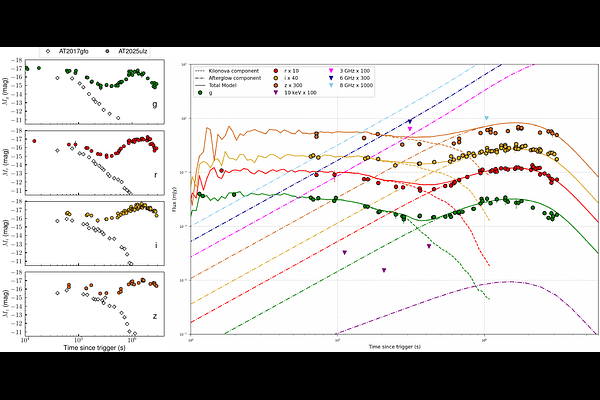
AbstractOn August 18, 2025, the LIGO-Virgo-KAGRA collaboration reported gravitational waves from a sub-threshold binary neutron star merger. If astrophysical, this event would have a surprisingly low chirp mass, suggesting that at least one neutron star was below a solar mass. The Zwicky Transient Facility mapped the coarse localization and discovered a transient, ZTF25abjmnps (AT2025ulz), that was spatially and temporally coincident with the gravitational wave trigger. The first week of follow-up suggested properties reminiscent of a GW170817-like kilonova. Subsequent follow-up suggests properties most similar to a young, stripped-envelope, Type IIb supernova. Although we cannot statistically rule out chance coincidence, we undertake due diligence analysis to explore the possible association between ZTF25abjmnps and S250818k. Theoretical models have been proposed wherein sub-solar neutron star(s) may form (and subsequently merge) via accretion disk fragmentation or core fission inside a core-collapse supernova i.e. a ``superkilonova". Here, we qualitatively discuss our multi-wavelength dataset in the context of the superkilonova picture. Future higher significance gravitational wave detections of sub-solar neutron star mergers with extensive electromagnetic follow-up would conclusively resolve this tantalizing multi-messenger association.