A Pixel-by-Pixel Path to Population III Discovery with JWST

A Pixel-by-Pixel Path to Population III Discovery with JWST
Patricia Iglesias-Navarro, Thomas Harvey, Marc Huertas-Company, Christopher C. Lovell, Johan H. Knapen, Christopher Conselice, Brant Robertson, Andrew J. Bunker, Stéphane Charlot, Natalia C. Villanueva, Hannah Übler, Zhiyuan Ji, Kevin Hainline, Christina C. Williams
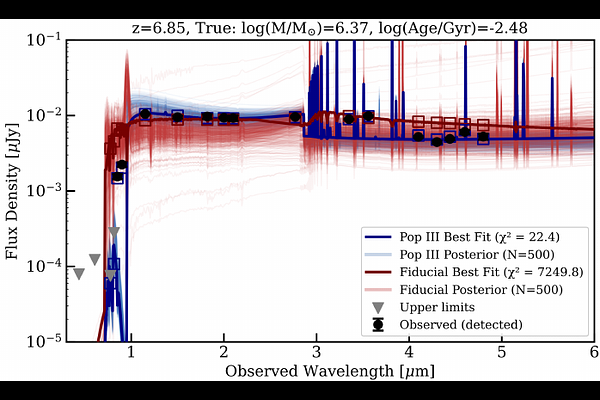
AbstractThe identification of the first generation of metal-free stars, known as Population III (Pop~III), remains a primary goal of modern observational astronomy. While JWST has discovered an abundance of UV-bright galaxies at $z > 10$, distinguishing primordial stellar populations from early metal-enriched systems is a significant challenge. We present an end-to-end framework that combines physically motivated forward modelling from Yggdrasil primordial models with simulation-based inference (SBI) to test Pop~III detectability in JWST-like observations, from isolated sources to realistic overlap with enriched (Pop~II) hosts. Our analysis spans several Pop~III initial mass function (IMF) assumptions, nebular configurations, and Lyman-$α$ transmission scenarios, while mocking the noise properties and filter coverage of the JWST Advanced Deep Extragalactic Survey (JADES). We find that unresolved or integrated analyses are strongly limited by host-galaxy contamination, whereas spatially resolved, pixel-based model comparison substantially improves recoverability. In our resolved experiments, detectability is highest for young and massive Pop~III clumps in nearly-quenched hosts at larger projected separations from their centres, reaching $\sim 90\%$ recovery in favourable configurations, while older and centrally embedded clumps are rarely recovered. Applying the framework to a literature candidate yields spatially differentiated behaviour: a compact blue companion is preferentially described by Pop~III-like models, while the host is better explained by fiducial Pop~I/II models. Our pipeline provides practical criteria for future searches and motivates imaging-first, spectroscopy-assisted strategies for identifying primordial stellar populations in JWST data.