Discrepancies between Chandrasekhar's theory of relaxation and $N$-body simulations

Discrepancies between Chandrasekhar's theory of relaxation and $N$-body simulations
Kerwann Tep, Douglas C. Heggie
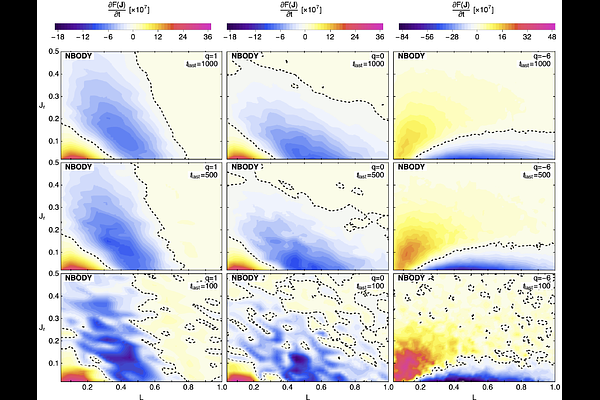
AbstractGlobular clusters are systems which are known to be particularly well described by two-body relaxation. In recent decades many studies have shown that Chandrasekhar's orbit-averaged theory is able to reproduce many features of numerical simulations. However, it has been claimed that differences between the theory and simulation remain, such as an amplitude mismatch of the rate of change of the distribution function. In this paper we compare the theoretical predictions of Chandrasekhar's theory for anisotropic clusters to precise $N$-body data. We show that more careful $N$-body measurements are able to reduce the claimed mismatch. Nevertheless, we observe a dependency of the remaining mismatch on both position and anisotropy. While the dependence on anisotropy may be understood qualitatively on theoretical grounds, the radial dependence implies that spatial inhomogeneities, and therefore collective effects, may become unavoidable to resolve the residual mismatch between theory and simulations.