The Engine and its Flows: Little Red Dot spectra are shaped by the column densities of their gas envelopes

The Engine and its Flows: Little Red Dot spectra are shaped by the column densities of their gas envelopes
Jorryt Matthee, Alberto Torralba, Gabriele Pezzulli, Rohan P. Naidu, John Chisholm, Sara Mascia, Jenny E. Greene, Yuzo Ishikawa, Max Gronke, Stijn Wuyts, Rongmon Bordoloi, Gabriel Brammer, Seok-Jun Chang, Anna-Christina Eilers, Anna de Graaff, Raphael E. Hviding, Edoardo Iani, Garth Illingworth, Daichi Kashino, Ivo Labbe, Yilun Ma, Michael V. Maseda, Romain Meyer, Erica Nelson, Pascal Oesch, Mengyuan Xiao
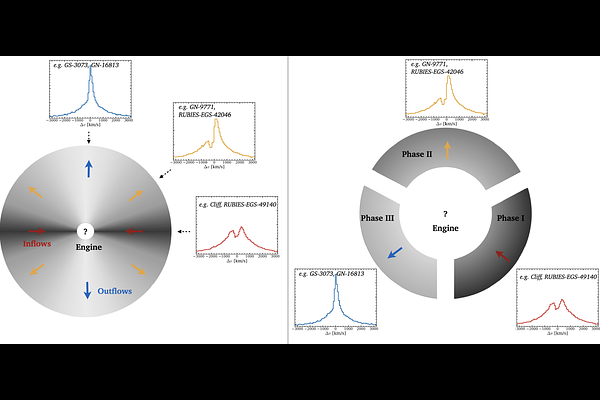
AbstractJWST data have enabled the abundant identification of compact broad Balmer line sources nicknamed the Little Red Dots. While they share broad lines with active galactic nuclei, they are unusually X-ray and infrared weak. We investigate the origin of the Balmer line profiles based on an empirical analysis of 18 broad H$α$-selected sources with high quality spectra at $z\approx3-7$. The H$α$ line profiles vary systematically with Balmer break strength: sources with blue UV to optical colors show a narrow core profile, redder sources with Balmer breaks a blue shifted absorption (P Cygni shape), and the reddest sources display absorption-dominated cores. All H$α$ lines have symmetric exponential wings, which are more dominant and slightly broader in red sources. Balmer absorption is present in $\sim60$ % of the sample, with H$β$ showing relatively stronger absorption. Drawing upon empirical analogies with stellar phenomena, we interpret these trends as being due to radiative processes that depend on variations in the optical depth, ionisation state and column density of a clumpy, partially ionised envelope. We unveil a correlation between the absorber velocity and Balmer break strength, with the densest absorbers inflowing and bluer sources having faster outflows. This indicates viewing angle or evolutionary effects where optically thick gas is inflowing, as suggested in models of super-Eddington accretion, and the engine can more easily drive outflows in directions with lower column densities. This new understanding of Balmer line profiles as tracing gas properties rather than dynamical broadening helps resolve tensions associated with high inferred black hole masses from standard virial calibrations, and reveals the complex gas environment around the hot central engine.