Late-Time HST UV Detections Reveal Eruptive Mass Loss and Circumstellar Interaction in a Quarter of Stripped-Envelope Supernovae

Late-Time HST UV Detections Reveal Eruptive Mass Loss and Circumstellar Interaction in a Quarter of Stripped-Envelope Supernovae
C. Fremling, S. Covarrubias, J. Sollerman, K. De, T. X. Chen, T. -W. Chen, R. Dekany, C. Fransson, A. Gal-Yam, S. L. Groom, W. V. Jacobson-Galán, M. M. Kasliwal, R. Lunnan, E. O. Ofek, D. A. Perley, J. N. Purdum, S. Schulze, Y. Sharma, N. Sravan, A. Wei, Lin Yan, Y. Yao
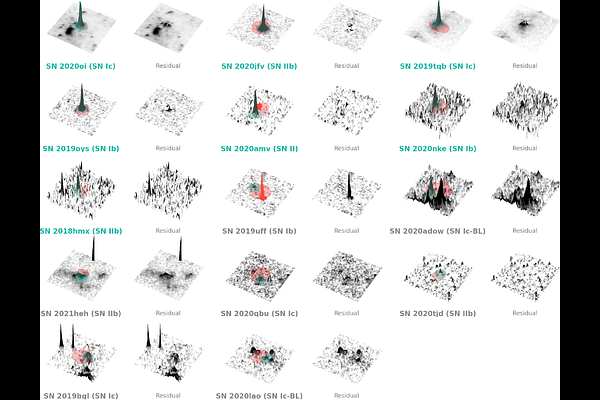
AbstractWe present HST WFC3/UVIS F275W near-UV imaging of 91stripped-envelope supernovae (SE SNe; Types IIb, Ib, Ic) from Snapshot program SNAP-16657, observed at phases of 270-1845 days (median 952 days) after first optical detection. We detect UV counterparts in 13 SE~SNe, of which 6 are classified as secure and 7 as ambiguous after comparison to nearby H\textsc{ii} regions, interpreting the secure sources as signatures of interaction with circumstellar material (CSM). Independent WISE W1/W2 light curves show $>300$ day mid-IR excesses in two of the secure UV sources, corroborating the interaction interpretation, and reveal two additional IR-only candidates without UV counterparts, indicating dust-obscured interaction episodes missed by the UV survey. A forward-modeling MCMC analysis using a physics-based CSM interaction model with three free parameters, the interaction fraction $f_\mathrm{CSM}$, shell mass $M_\mathrm{CSM}$, and thickness fraction $f_\mathrm{thick}$, yields $f_\mathrm{CSM} = 0.23^{+0.17}_{-0.09}$, $M_\mathrm{CSM} \approx 0.013~M_\odot$, and $f_\mathrm{thick} \approx 0.07$. The inferred thin-shell geometry implies an ejection duration of $\sim$6 yr for an outflow velocity of $300$ km s$^{-1}$, two to three orders of magnitude shorter than the thermal timescale of stable Roche-lobe overflow. This result disfavors steady binary mass transfer as the origin of the detected CSM and instead points to eruptive pre-supernova mass ejection in the final years before core collapse, either from wave-driven outbursts or from mass transfer triggered by late-stage progenitor re-expansion.