The shape and spin state of (275677) 2000 RS11 from ground-based radar and optical observations

The shape and spin state of (275677) 2000 RS11 from ground-based radar and optical observations
Richard E. Cannon, Agata Rożek, Kaley Brauer, Michael W. Busch, Colin Snodgrass, Lance A. M. Benner, Marina Brozović, Jon D. Giorgini, Ellen Howell, Michael C. Nolan, Markus Rabus, Sedighe Sajadian, Alessondra Springmann, Patrick A. Taylor, Luisa Fernanda Zambrano-Marin
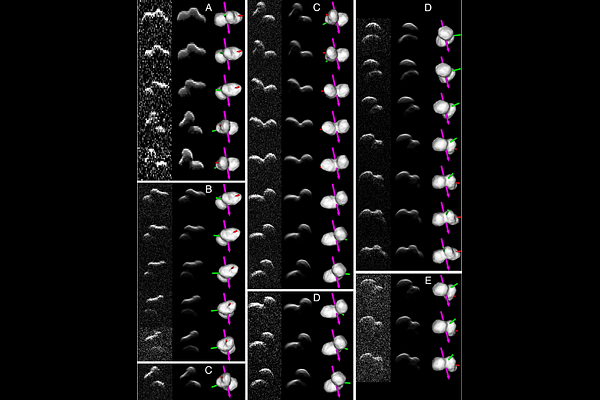
AbstractNear-Earth asteroid (275677) 2000 RS11 was observed over 5 days in March 2014 with both the Arecibo (2380 MHz, 12.6 cm) and Goldstone (8560 MHz, 3.5 cm) planetary radar systems. The continuous-wave spectra and delay-Doppler images collected revealed a sub-km-sized object with a strongly bifurcated shape. We used these radar observations, in combination with 7 optical lightcurves collected in 2014 and one lightcurve from 2023, to create a comprehensive shape and spin-state model for RS11. We find a rotation period of P = (4.445+-0.001) hours around a pole of lambda = (225+-80) and beta = (-80+-9) relative to the plane of the ecliptic. The shape of RS11 is unusual in that it does not resemble many of the other near-Earth asteroids modelled with ground-based radar. Whilst RS11 consists of a largely spherical, smaller lobe attached to an elongated, larger lobe via a narrow neck, the smaller lobe is not aligned with the long axis of the larger lobe, but is closer to the larger lobe's shortest principal axis. In combination with a large concavity observed on the outer face of the larger lobe, this may point to an unusual formation or event in the object's past. We estimate that RS11 has an geometric albedo of (0.16+-0.06) and a radar albedo between 0.08 and 0.16. Analysis of its gravitational environment reveals that for standard S-type asteroid densities, we would not expect rotational instability and it is possible for RS11 to be a low tensile strength rubble-pile asteroid.