Outflow Properties from a Broad Range of GR$ν$RMHD Stellar-Mass Black Hole Accretion Disks

Outflow Properties from a Broad Range of GR$ν$RMHD Stellar-Mass Black Hole Accretion Disks
Marko Ristić, Jonah M. Miller, Richard O'Shaughnessy, Matthew R. Mumpower, Christopher J. Fontes, Chris L. Fryer, Ryan T. Wollaeger
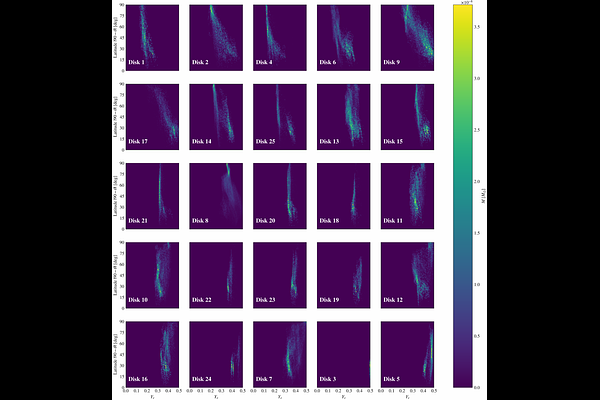
AbstractThe majority of the mass ejected by neutron star mergers comes from accretion disk outflows. Over timescales of seconds, the thermodynamic evolution of the disk and its resultant outflows set the stage for the ejecta properties which manifest in kilonova observations at later times (hours/days). Kilonova observables depend sensitively on key properties of these outflows -- mass ejection, the ejecta velocity distribution, late-time ejecta morphology and nucleosynthetic yields -- which can only be modeled with a detailed treatment of microphysical interactions including neutrino and general relativistic effects. In this work, we present a library of 25 general-relativistic magnetohydrodynamic accretion disks with neutrino transport, to our knowledge the largest to date, spanning a broad range of black hole and accretion disk combinations. From fits to our simulations, we derive analytic estimates of the average ejecta velocity distribution and mass ejection both at simulation end and extrapolated out to the end of the disk's lifetime. We also report ejecta morphology at timescales relevant to kilonova modeling, present spatially-dependent nucleosynthetic yields, and discuss the latter's dependence on initial disk conditions. While our disk library primarily includes initial conditions expected after neutron star mergers, a subset of our disks are applicable to other kilonova-adjacent scenarios.