Interstellar Object 3I/ATLAS Observed from Mars by China's Tianwen-1 Spacecraft

Interstellar Object 3I/ATLAS Observed from Mars by China's Tianwen-1 Spacecraft
Xin Ren, Wei Yan, Ruining Zhao, Shu Wang, Xingye Gao, Qiang Fu, Qing Zhang, Bin Yang, Man-To Hui, Zhiyong Xiao, Xiaodong Liu, Cunhui Li, Renhao Tian, Wenguang Liu, Dong Wang, Shaoran Liu, Cong Ren, Jie Dong, Xinbo Zhu, Pan Xie, Jian-Yang Li, Yan Geng, Jianjun Liu
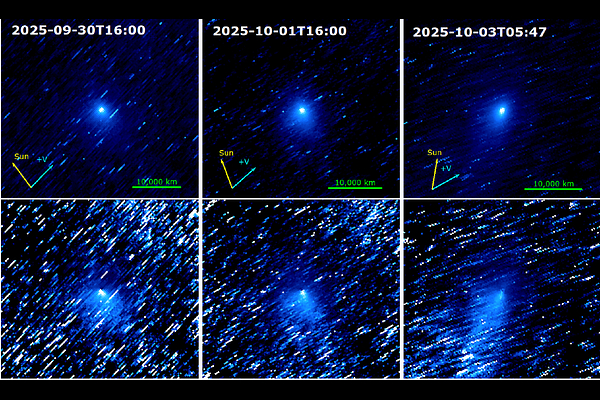
AbstractChina's Tianwen-1 Mars orbiter successfully imaged the third interstellar object, 3I/ATLAS, during its close encounter with Mars using the onboard HiRIC CMOS camera. This is China's first deep-space observation of an astronomical object. These observations constitute the first imaging of this object from a vantage point significantly out of its orbital plane, providing a unique constraint on dust dynamics. Three observing epochs between 2025 September 30 and October 3 reveal clear changes in coma and tail morphology driven by the rapidly evolving viewing geometry. Comparison with Finson-Probstein dust dynamical models indicates that the coma is dominated by large grains with solar radiation pressure parameter $β\approx 10^{-3} $ - $10^{-2}$, corresponding to grain sizes of a few 100s $μ$m. The extent of the sunward coma implies dust ejection velocities of $3$ - $10$ m s$^{-1}$. Despite the morphological evolution, the azimuthally averaged surface brightness profile remains nearly unchanged through the three epochs, transitioning from a radial slope near -1 close to the nucleus to slightly steeper than -1.5 at larger cometocentric distances, consistent with steady-state dust outflow accelerated by solar radiation pressure. Photometry yields an average $Afρ\sim (2.0\pm0.2)\times10^4$ cm and a corresponding dust mass loss rate of $\dot{M} \sim 10^3$ kg s$^{-1}$. The dominance of large grains in both interstellar comets discovered to date, 2I/Borisov and 3I/ATLAS, together with their high supervolatile contents, may indicate that these objects originate from the outer regions of their parent planetary disks.