Importance and Science Outcomes from the first XSPECT/XPoSat Workshop

Importance and Science Outcomes from the first XSPECT/XPoSat Workshop
Anuj Nandi, Rwitika Chatterjee, V. P. Shyam Prakash, Ankur Kushwaha, M. C. Ramadevi, Kiran M. Jayasurya, Vivek K. Agrawal, M. Varun, Karan Akbari, Arya Sudhakaran, Daneshwar Bhandari, Vishal Kale, Vishal Jadoliya, Suchismito Chattopadhyay, Sakshi Maurya, Swasthik Visakh S, Debasish Krishnatreya, M Dhamodhar Reddy, Akash Agarwal, Giridharan L., Meghamani Halder, Juris N. J., Athira Mohanan, P. Majumder, Arbind Pradhan, Deblina Lahiri, Abhishek Jhala, Garima Tyagi, Abhisek Tamang, Akshara S B, P Aromal, Sreetama Das Choudhury, Sunirmal Rana, Ajith Balu, Mary Bosco, Jeyaraman Ilangovan, Shivani Chaudhary, Bhranti Rao, Biyas Chowdhury, Joysankar Majumdar, Sanjeeva Rao Prattipati, Subhasish Das, Sandip Naskar, Swapnil Singh, Vaishali S, Koushal Vadodariya, Radhakrishna Vatedka, Anurag Tyagi, Sachin Narang, Prapti Mittal, Madhu K, Brindavan Mahto
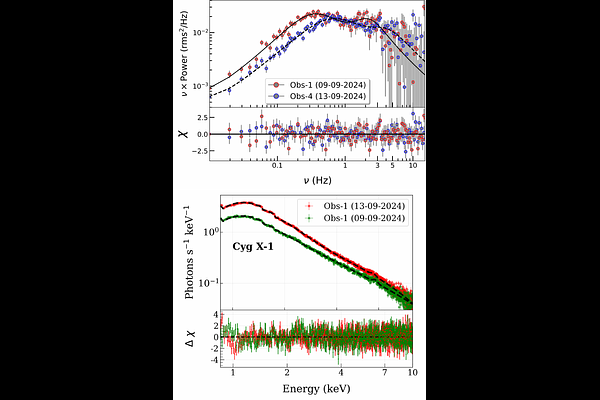
AbstractThis paper summarizes the science outcomes of the first Workshop on Data Analysis using observations from the XSPECT payload onboard the XPoSat, which brought together early-career researchers and experts to explore the instrument's scientific capabilities through lectures and hands-on analyses. Participants performed end-to-end data analysis, including calibration, spectral modeling, and timing studies, on seven sources comprising Neutron Star Low-Mass X-ray Binaries, pulsars, and Black Hole X-ray Binaries, demonstrating the instrument's scientific potential. The observations, obtained during the first year of XSPECT operations, together with in-house developed software, were provided to the participants, making them the first users outside the instrument team to analyze XSPECT data. For NS-LMXBs, Aql X-1 exhibited a classical Type-I X-ray burst, enabling constraints on the stellar radius through spectral fitting. Sco X-1, observed across its complete Z-track, revealed systematic spectral evolution driven by accretion-rate fluctuations and disk-corona coupling, while Cir X-1 displayed orbital phase-dependent transitions between hard and soft states, reflecting changes in accretion geometry. Among accretion-powered pulsars, GX 301-2 showed a double-peaked, energy-dependent pulse profile and strong iron fluorescence lines due to stellar wind reprocessing, whereas Vela X-1 exhibited orbital phase-dependent absorption and steady coronal temperatures. Among BH-XRBs, Cyg X-1 transitioned from a hard to soft-intermediate state with increasing disk contribution and spectral softening, while Cyg X-3 remained in the intermediate state with multiple emission lines originating from a clumpy stellar wind. The workshop outcomes highlight the scientific promise of XSPECT and the importance of collaborative training in maximizing the science from XSPECT and future Indian space astronomy missions.