Dark Energy with Constant Inertial Mass Density: Updated Constraints and Curvature-Induced Sign Transitions in $ρ_{\rm DE}$ and $ρ_{\rm DE}+p_{\rm DE}$

Dark Energy with Constant Inertial Mass Density: Updated Constraints and Curvature-Induced Sign Transitions in $ρ_{\rm DE}$ and $ρ_{\rm DE}+p_{\rm DE}$
Luis A. Escamilla, Berat Karadavut, Nihan Katırcı
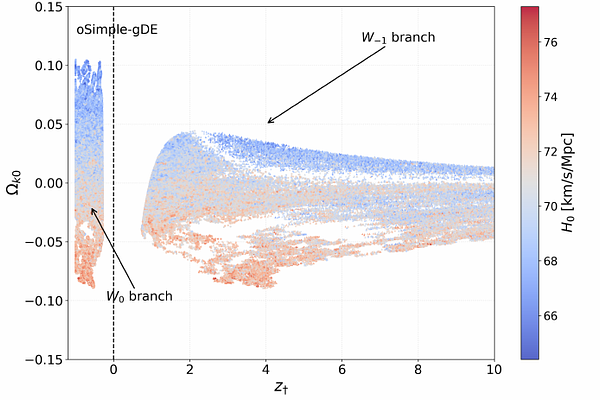
AbstractWe present updated observational constraints on the simple-gDE model, characterized by a constant inertial mass density (IMD) $ρ_{\rm DE}+p_{\rm DE}$,which belongs to the broader graduated dark energy family, and compare its cosmological implications with those of the $w$CDM and the $Λ$CDM models. This parametrization provides a physically motivated, one-parameter extension of $Λ$CDM, perspective on DE dynamics beyond the usual equation-of-state approach. We use the newly released DESI DR2 BAO data in combination with either CMB measurements from Planck 2018 or late-time probes, CC and the Pantheon+ SNe Ia sample, considered both with and without SH0ES calibration in this analysis. The data favor a small positive IMD, and Bayesian evidence indicates that the models remain statistically indistinguishable within spatially flat scenarios. Consequently, none of these models exhibits a sign transition in the DE energy density, and no improvement in $H_0$ tension. Allowing spatial curvature qualitatively enlarges the phenomenology of the dark sector. In particular, the interplay between spatial curvature and a nonzero IMD permits sign transitions in both the effective dark-energy density and the IMD during cosmic evolution. For the BAO+CC+SN+SH0ES dataset, the $o$Simple-gDE model yields a transition redshift $z^\dagger = 1.51^{+0.68}_{-0.34}$, while the crossing of the Null Energy Condition boundary (NECB), defined by $ρ_{\rm DE}+p_{\rm DE}=0$, occurs at $z_{\rm NECB}=2.36^{+1.48}_{-1.48}$. The model is statistically favored over $oΛ$CDM and $ow$CDM. These results highlight the potential role of IMD as a fundamental parameter in DE phenomenology and demonstrate that geometric effects, such as spatial curvature, can reveal dynamical features of the dark sector that remain hidden within the spatially flat $Λ$CDM framework.