Neutrino Spectral Pinching in 3D Core-Collapse Supernovae: Late-Time Convergence, Failed-Explosion Signatures, and Viewing-Angle Dispersion

Neutrino Spectral Pinching in 3D Core-Collapse Supernovae: Late-Time Convergence, Failed-Explosion Signatures, and Viewing-Angle Dispersion
Nicolás Viaux M
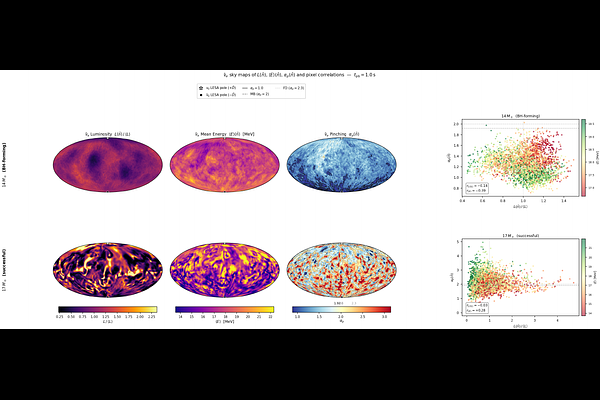
AbstractWe present a systematic survey of the neutrino spectral pinching parameter alpha_p(t, M, n-hat) across the Princeton Fornax ensemble of 3D core-collapse supernova simulations. We analyze 25 simulations spanning progenitor masses 8.1-100 M_sun with durations up to 8.47 s post-bounce, computed with the Fornax code and the SFHo equation of state. The pinching parameter alpha_p = (2^2 - E_rms^2)/(E_rms^2 - ^2) is derived from 12-bin spectral moments on a 128x256 sky grid for three neutrino species, enabling time- and angle-resolved spectral characterization. Four results emerge. (1) The nu-bar_e pinching floor is alpha_p = 1.92 +/- 0.10 (N=13 long-running models), lying 0.2-0.4 below 1D predictions due to 3D PNS convection. (2) Both BH-forming models (12.25, 14 M_sun) show anti-pinching (alpha_p < 0.9) before collapse, with deficit Delta alpha_p ~ 0.65 visible from t = 0.5 s. (3) Two of six long-running models exhibit a hierarchy reversal ( > ) after t = 5 s; leptonic flavors carry (40 +/- 3)% of radiated energy. (4) The LESA dipole is suppressed by >3x in BH-forming models; viewing-angle spread Delta alpha_p(68%) ~ 0.8-1.5 dominates spectral-inversion uncertainty. Mollweide sky maps reveal coherent angular structures with alpha_p anticorrelated with luminosity and correlated with mean energy. Detection rates at Hyper-Kamiokande, DUNE, JUNO, and IceCube yield 8-12% NMO/IMO discrimination during Kelvin-Helmholtz cooling. The late-time nu-bar_e pinching floor represents the first 3D characterization of spectral convergence during Kelvin-Helmholtz cooling, lying 0.2-0.4 below 1D predictions, a direct signature of 3D PNS convective transport