Spectral Hierarchy of the Cosmic Web

Spectral Hierarchy of the Cosmic Web
Francisco-Shu Kitaura, Francesco Sinigaglia
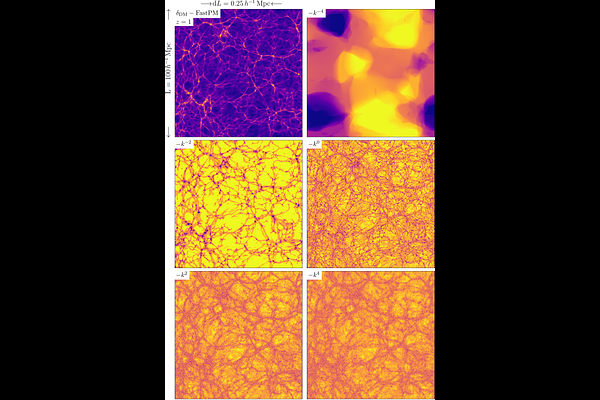
AbstractWe introduce a spectral hierarchy of cosmic-web classifications obtained by applying simple scale-weighting kernels to the density field before performing a standard eigenvalue-based web classification. This unifies and extends several widely used web definitions within a single framework: the familiar potential/tidal web (large-scale, nonlocal), a curvature-based web (more local, peak- and ridge-sensitive), and additional higher-derivative levels that progressively emphasize smaller-scale structure. Because the classification is built from second derivatives of the filtered field, successive hierarchy levels align naturally with operator families that appear in renormalised bias and effective descriptions of large-scale structure, providing an explicit bridge between cosmic-web environments and long- and short-range nonlocal bias ingredients. We quantify the information content of the hierarchy with a compact statistic: we map each cell to one of four ordered web types (void, sheet, filament, knot), construct a corresponding ``web contrast'' field, and measure its cross-correlation with halos from the AbacusSummit simulation suite on a coarse mesh with $ΔL\simeq 5.5\,h^{-1}\mathrm{Mpc}$. We find that the hierarchy retains significant tracer-relevant information from very large scales down to the mesh Nyquist limit, with the more local (curvature/higher-derivative) levels dominating toward nonlinear scales. This makes the spectral hierarchy a practical, interpretable conditioning basis for fast mock-galaxy production and field-level modelling, and a flexible tool for studying environment-dependent clustering and assembly bias.