Impact of Sub-2.5 MeV 12C+12CResonances on the Production of Elements from C to Pd in Core-Collapse Supernovae

Impact of Sub-2.5 MeV 12C+12CResonances on the Production of Elements from C to Pd in Core-Collapse Supernovae
L. Roberti, S. Palmerini, A. Falla, L. Boccioli, F. Andreis, A. Chieffi, M. La Cognata, M. Limongi, M. Masci, A. Nurmukhanbetova, A. Oliva, R. Spartá, A. Tumino
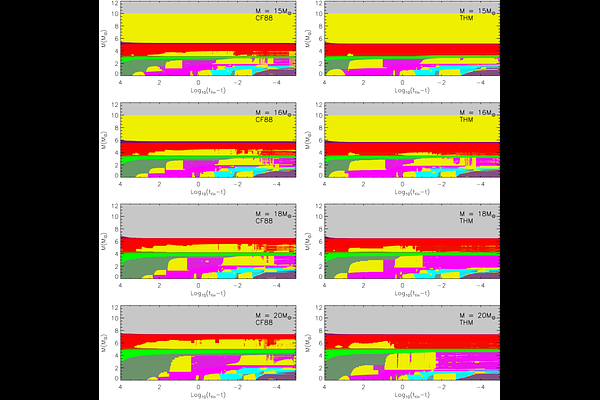
AbstractWe explore the impact of a more efficient 12C+12C reaction on the structure and nucleosynthesis of massive stars. We calculate non-rotating stellar models with initial masses of 15, 16, 18, 20, 22, 25, and 40 Msun and solar metallicity by means of the FRANEC code. Furthermore, we simulate the core-collapse supernova of these models with the thermal bomb technique, using two different approaches to inject the thermal energy into the pre-supernova structure. Our results show that a more efficient 12C+12C rate extends the duration of the central carbon burning phase, developing more massive convective cores and leading to a different and less compact pre-supernova structure with respect to models calculated with a standard 12C+12C rate. These structural differences significantly impact nucleosynthesis. In particular, an increased rate enhances the production of elements heavier than Fe, produced by the s-process nucleosynthesis and driven by the more efficient activation of the 13C($α$,n) neutron source in the early carbon burning shells. We find that the differences in the chemical composition of the core-collapse supernova ejecta are primarily determined by these pre-supernova structural changes, which dominate over the effects of different explosion prescriptions.