Half-wave-plate non idealities propagated to component separated CMB $B$-modes

Half-wave-plate non idealities propagated to component separated CMB $B$-modes
Ema Tsang-King-Sang, Josquin Errard, Simon Biquard, Pierre Chanial, Wassim Kabalan, Wuhyun Sohn, Radek Stompor
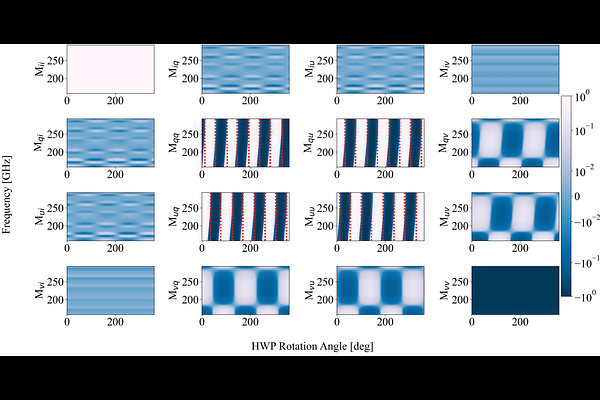
AbstractWe assess the impact of non-ideal, continuously rotating half-wave plates (HWPs) on cosmic microwave background (CMB) polarization measurements targeting large angular scale signal. Such hardware solutions are used in or planned for multiple modern CMB efforts, both ground-based, for instance, small aperture telescopes of Simons Observatory or satellite borne, such as LiteBIRD. Using a frequency-dependent parametric model based on the Mueller matrix formalism, we characterize the induced mixing of Stokes parameters. Through end-to-end simulations, we propagate these effects from time-ordered data to cosmology via map-making and component-separation stages, quantifying their impact on the $B$-modes power spectrum and the tensor-to-scalar ratio, $r$. Our analysis shows that neglecting the frequency dependence of a three-layer HWP gives rise to significant polarization leakage, biases foreground spectral parameters, and leads to residual contamination in the recovered CMB maps. To mitigate these effects, we investigate multiple analysis strategies progressively incorporating a more complete description of the instrumental response. At the map-making level, this requires generalizing the standard pointing matrix to account for the full time- and frequency-dependent instrumental response. We find that standard HWP models, reduce the biases only down to $r \sim 10^{-2}$, while a more advanced approach based on a generalization of both map-making and component separation, implemented using JAX, can suppress it down to $r \sim 7 \times 10^{-4}$. Finally, we extend this approach to a time-domain component-separation, enabling a statistically consistent treatment of instrumental response in the presence of time-domain features. We demonstrate its feasibility and validate it by performing a full end-to-end analysis, recovering results in good agreement with the map-based ones.