Radiation-pressure instability is an artifact of constant-$α$ closure

Radiation-pressure instability is an artifact of constant-$α$ closure
M. H. Naddaf, M. Ghasemnezhad, H. Ghanbarnejad, D. Hutsemékers, B. Czerny
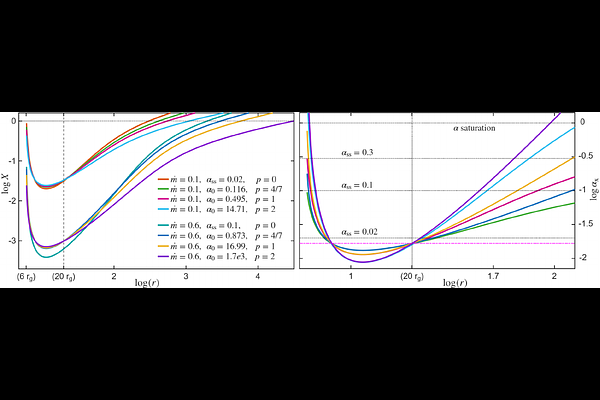
AbstractThe standard $α$-disk formalism parametrizes turbulent angular momentum transport through a dimensionless coefficient $α$, assumed to be spatially and thermodynamically invariant. While analytically convenient, this assumption leads to the well-known thermal and viscous instabilities in radiation-pressure dominated (RPD) regions. We show that this instability is not the consequence of radiation pressure, but is due to enforcing a constant $α$ across distinct thermodynamic regimes. Requiring the steady thin-disk (TD) to remain thermally stable and single-valued in the $\dot{M}$--$Σ$ plane yields a necessary condition on the stress response, expressed as $η_{\rm x} \equiv d\lnα_{\rm x}\,/\,d\ln X > 4/7$, where $X \equiv P_{\rm gas}/P_{\rm rad}$. The resulting viscosity law $α_{\rm x} \equiv α(X)$ emerges directly from the internal consistency of TD equations, without modifying the stress law or invoking any additional physics. $α_{\rm x}$ removes the RPD unstable branch. The disk structure becomes smooth and globally single-valued, with higher $Σ$ and $τ$ in the inner RPD disk, while preserving the standard effective-temperature profile. This increases thermal and inflow timescales, offering a natural route to accretion-state dependent variability without large-amplitude radiation-pressure limit cycles. It also motivates revisiting AGN disk tensions, including microlensing sizes and continuum reverberation lags with improved radiative-transfer modeling. The results show that the RPD instability, and possibly some associated AGN disk tensions, reflect an inconsistent viscosity closure.