A White Dwarf Tidal Disruption by an Intermediate-Mass Black Hole as the Progenitor of Ultra-long GRB 250702B

A White Dwarf Tidal Disruption by an Intermediate-Mass Black Hole as the Progenitor of Ultra-long GRB 250702B
Chengchao Yuan, Ning Jiang, Zi-Gao Dai
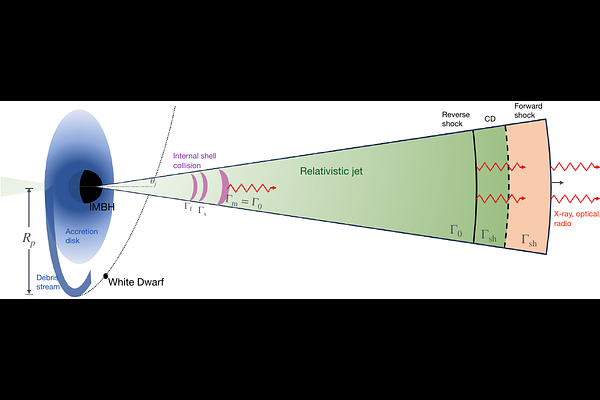
AbstractThe recent detection of GRB 250702B, the longest gamma-ray burst observed to date with prompt emission lasting $\sim 2.5\times 10^4$ seconds, challenges the conventional collapsar model. Its remarkable features--including an extraordinary X-ray flare at $\sim 1.3$ days post-detection, a late-time transition from steep to shallow decay in the X-ray afterglow, and hard spectra extending from keV to MeV energies--point to a novel progenitor. Here we show that these multiwavelength signatures can be consistently explained by a relativistic jet powered by successive partial tidal disruptions of a white dwarf (WD) by an intermediate-mass black hole (IMBH). By modeling the time-dependent accretion rate from repeated partial disruptions and the resulting jet evolution, we show that the external forward and reverse shocks account for the long-term X-ray, near-infrared, and radio afterglow, whereas the luminous X-ray flare originates from internal energy dissipation caused by collisions between fast and slow relativistic ejecta associated with the final complete disruption. Our findings establish IMBH-WD tidal disruption events as a viable engine for ultra-long GRBs.