Self-consistent dynamical modelling of the Milky Way bar with orbital frequency analysis

Self-consistent dynamical modelling of the Milky Way bar with orbital frequency analysis
Zachary Langford, Robyn Sanderson, Madeline Lucey, Jason A. S. Hunt
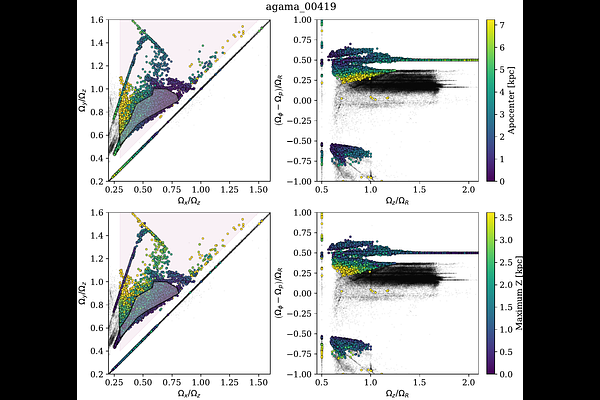
AbstractWe present an update to the frequency analysis method for measuring the properties of a galactic bar. The method involves computing the fundamental frequencies of orbits in rotating, N-body-derived potential models, classifying the stars as members of bar supporting orbits, and finding the extent of the apo-centre distribution. In this work, we apply an updated classification criterion designed to isolate the so-called "Warm" inner Lindblad resonance (ILR) orbits. These orbits have been shown to contain the looped x1 orbits, which dominate the "shoulder regions" of the bar and largely contribute to the radial extent. We apply this method to existing Gaia, APOGEE, and OGLE data of more than 200,000 stars to constrain the properties of the Milky Way bar. We find that multiple bar lengths and pattern speeds are consistent with the data to within 5 percent.