Measurements on the kinetic origin of streamer dynamics

Measurements on the kinetic origin of streamer dynamics
Forrest Mozer, Kyungeun Choi, Richard Sydora, Andrii . Voshchepynets
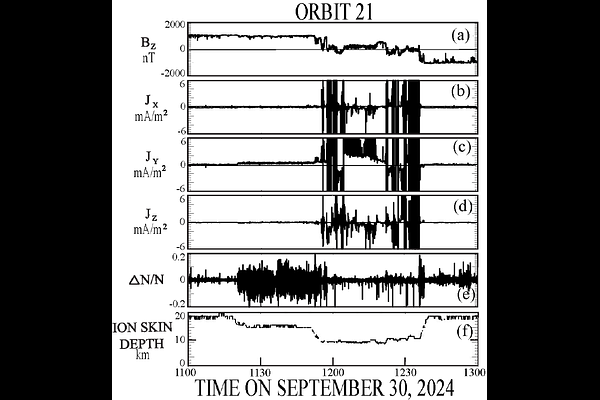
AbstractA fundamental problem of solar physics is understanding the transition from the closed-loop magnetic environment of the corona to the open, radial structure of the heliospheric current sheet. While the large-scale heliospheric dynamics are in the MHD regime, the outer corona physics must involve non-MHD processes, none of which have been directly resolved in-situ until now. To approach this problem, 15 streamer structures observed by the Parker Solar Probe (PSP) during Orbits 16 through 23, at radial distances of 11.7 to 17 solar radii, have been measured. DC electric fields in the plasma rest frame, reaching magnitudes up to 400 mV/m, the largest electric fields measured in the PSP mission, were observed. They do not result in an ExB drift because that component of the electric field was removed in transforming the data from the spacecraft frame to the plasma rest frame. Instead, these fields are interpreted via the Generalized Ohms Law. . The Hall term in this law produces estimates of the local current density that show it primarily flows in the meridional direction at amplitudes of several mA/m2, to support the forming heliospheric current sheet (HCS). ). In addition, it was found that the plasma flow speeds inside the current sheets exceeded those outside the sheets in six of the 15 examples, and the 326 km/sec average speed inside the current sheet exceeded the average speed of 266 km/second outside the region. Such findings challenge the traditional consensus that streamers are the source of the "slow" solar wind.