D$_4$CNN$\times$AnaCal: Physics-Informed Machine Learning for Accurate and Precise Weak Lensing Shear Estimation

D$_4$CNN$\times$AnaCal: Physics-Informed Machine Learning for Accurate and Precise Weak Lensing Shear Estimation
Shurui Lin, Xiangchong Li, Ji Li, Shengcao Cao, Xin Liu, Yu-Xiong Wang
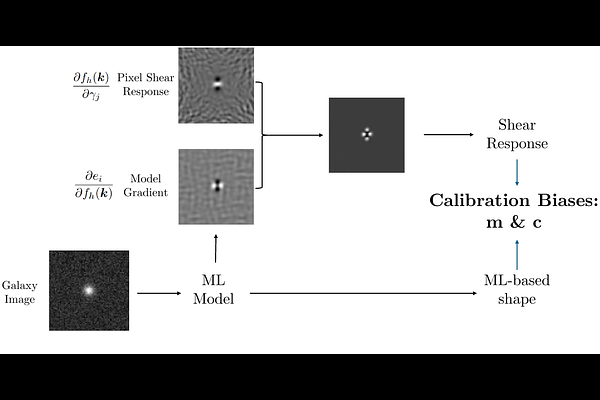
AbstractTraditional weak gravitational lensing shear estimators are carefully calibrated but struggle to fully capture realistic galaxy morphologies, point-spread-function (PSF) effects, blending, and noise in deep surveys, while blindly trained machine learning (ML) models can introduce significant calibration biases. Here we construct a fully D$_4$-equivariant deep neural network for galaxy shape measurement whose architecture enforces symmetry under 90$^{\circ}$ rotations and mirror transformations, and adopt the Analytical Calibration framework (AnaCal) to calibrate the model using its backpropagated gradients. For isolated galaxies in LSST-like single-band simulations, we demonstrate that our approach achieves $\sim$10% lower shape noise than the traditional moment-based Fourier Power Function Shapelets estimator in the high-noise regime, equivalent to a $\sim$20% gain in effective galaxy number density, while simultaneously achieving multiplicative biases consistent with zero across a wide range of noise levels, PSF sizes and ellipticities, and magnitude selection cuts, with all measurements satisfying $|m| {<} 10^{-3}$ (i.e., within the 0.2% LSST requirement) and most at the ${\sim}10^{-4}$ level. We demonstrate this framework on isolated single-band galaxy images with Gaussian noise and known PSF, establishing a rigorous, physics-informed foundation for future extensions of ML-based shear estimation to blended sources and multi-band observations in Stage-IV surveys. All codes and data products will be made publicly available upon acceptance.