The assembly and fate of a giant disc galaxy in a protocluster at $z = 3$

The assembly and fate of a giant disc galaxy in a protocluster at $z = 3$
Francesca Rizzo, Pavel E. Mancera Piña, Gabriele Pezzulli, Giulia Despali
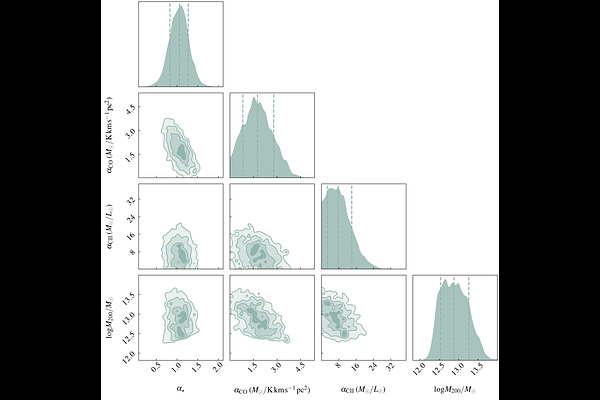
AbstractRecent JWST observations revealed two massive ($M_{\star} \gtrsim 10^{11}\,M_{\odot}$), unexpectedly large spiral galaxies at $z \sim 3$, both in overdense environments. We focus on one of these, ADF22.1 at $z = 3.09$, which hosts an active galactic nucleus (AGN), exploiting its extended [CII] emission ($\sim$30 kpc in diameter) with high-resolution observations from the Atacama Large Millimetre Array and JWST. We find a flat outer rotation curve reaching $\sim$530 km s$^{-1}$, and perform, for the first time for a system of this type, a rotation-curve decomposition. We infer a dark-matter halo mass of $\log(M_{200}/M_{\odot})=12.9^{+0.4}_{-0.3}$, a baryon-to-halo mass ratio of $0.4^{+0.6}_{-0.3}$ in units of the cosmological baryon fraction, and a ratio between the baryonic and dark-matter halo specific angular momentum of $1.0^{+0.7}_{-0.5}$. Comparing these quantities with those of local galaxies, we find that ADF22.1 is indistinguishable from $z=0$ giant discs, pointing to the inefficiency of AGN feedback in halting disc growth. Using the Mapping Nearby Galaxies at Apache Point Observatory survey, we identify potential $z=0$ descendants of ADF22.1, suggesting it will evolve into an extreme (in either mass or angular momentum) early-type galaxy. Finally, we argue that cold-stream accretion, invoked to explain disc formation at $z > 1$, cannot simultaneously account for its size, dynamical properties, high specific angular momentum, and baryon-to-halo mass ratio. Instead, sustained accretion from the hot circumgalactic medium, either via spontaneous or fountain-driven condensation, offers a more physically plausible formation pathway.