Millimeter dust continuum and polarization in protoplanetary disks with scattering: A slab model

Millimeter dust continuum and polarization in protoplanetary disks with scattering: A slab model
Naoya Kitade, Akimasa Kataoka
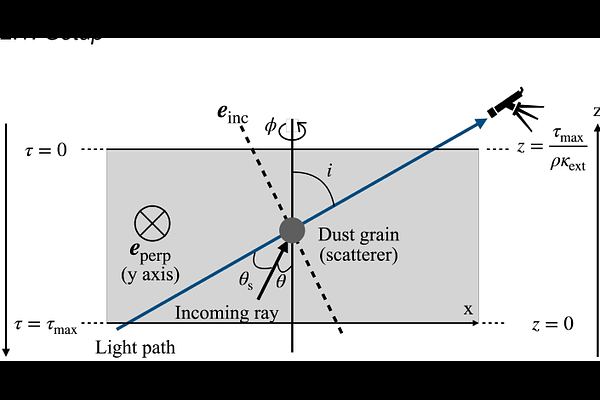
AbstractMillimeter continuum emission and self-scattering polarization from protoplanetary disks are widely used to constrain dust properties. Interpreting these observations requires practical prescriptions for the disk emission. However, only approximate formulae are available for the continuum emission, and no widely applicable formula has yet been established for the polarized emission. We aim (i) to assess the validity of commonly used analytic approximations for the (sub)millimeter continuum emission from protoplanetary disks, and (ii) to derive realistic prescriptions for the disk emission for both the continuum and the polarization. We numerically solve the radiative transfer equation in an isothermal, constant-density plane-parallel slab, including dust absorption, emission, and self-scattering with full Stokes parameters. We find that commonly used analytic approximations for the continuum emission are systematically about 10 to 15% lower than our numerical solutions. Consequently, SED analyses of (sub)millimeter observations that adopt these formulae are likely to overestimate the optical depth (and thus the disk mass) and the dust temperature, and underestimate the albedo (and thus altering the inferred constraints on grain size). We also provide empirical fitting formulae that reproduce our numerical results for the continuum emission and polarization fraction. These formulae will enable observational data analyses to be carried out more accurately and efficiently than with the conventional approaches. For the analysis of (sub)millimeter observations, we recommend using our new empirical formulae or interpolation of our numerical results, rather than commonly used approximations.