McFACTS IV: Electromagnetic Counterparts to AGN Disk Embedded Binary Black Hole Mergers

McFACTS IV: Electromagnetic Counterparts to AGN Disk Embedded Binary Black Hole Mergers
Emily McPike, Rosalba Perna, K. E. Saavik Ford, Barry McKernan, Vera Delfavero, Miranda McCarthy, Kaila Nathaniel, Jake Postiglione, Nicolas Posner, Varun Pritmani, Shawn Ray, Richard O'Shaughnessy
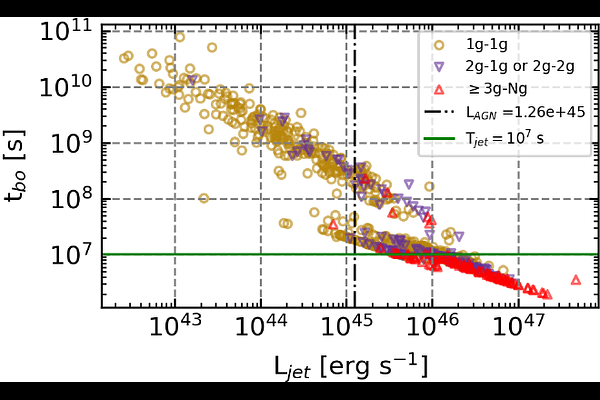
AbstractThe accretion disks of active galactic nuclei (AGN) are promising environments for producing binary black hole (BBH) mergers, which have been detected via gravitational waves (GW) with LIGO-Virgo-KAGRA (LVK). BBH mergers embedded in AGN disks are unique among GW formation channels in their generic ability to produce electromagnetic (EM) counterparts, via interactions between the merger remnant and the surrounding disk gas (though these are not always observable). While such mergers represent valuable multi-messenger sources, the lack of predictive statistical models in existing literature currently limits our ability to select possible EM counterparts with GW detections in archival data and in real time using time-domain surveys such as ZTF or LSST. Here, we employ the Monte Carlo For AGN Channel Testing and Simulation code (\texttt{McFACTS}\footnote{https://www.github.com/mcfacts/mcfacts}) to predict the bolometric luminosities of jets and shocks associated with LVK-detectable BBH merger remnants in AGN disks. \texttt{McFACTS} predicts the distribution of GW observables for an underlying BH population and disk model. In this work we present a new capability that simultaneously generates the distribution of bolometric EM luminosities corresponding to these predicted GW detections. We show that (i) migration traps in dense, Sirko-Goodman-like AGN disks efficiently drive hierarchical BH mergers, yielding high-mass, high-spin BH remnants capable of powering observable EM counterparts across merger generations; and ii) mergers embedded in sufficiently dense disks with chirp mass $\mathcal{M}\gtrsim40M_\odot$ are highly likely to yield observable EM counterparts for sufficiently long-lived disks and top-heavy BH initial mass functions.