Geometric tracking of a halo CME using full-circle wide-field views from PUNCH

Geometric tracking of a halo CME using full-circle wide-field views from PUNCH
Craig E. DeForest, Kieran A. Russell, Samuel Van Kooten, Heather A. Elliott, Maher A. Dayeh, Sarah E. Gibson, Anna Malanushenko, David F. Webb, Ronnie Killough, Jillian Redfern, William L. Wells, Matthew N. Beasley, Glenn T. Laurent, Nick R. Waltham, J. Marcus Hughes, Daniel B. Seaton, Ritesh Patel, Chris Lowder, Derek A. Lamb, Alec R. DeForest
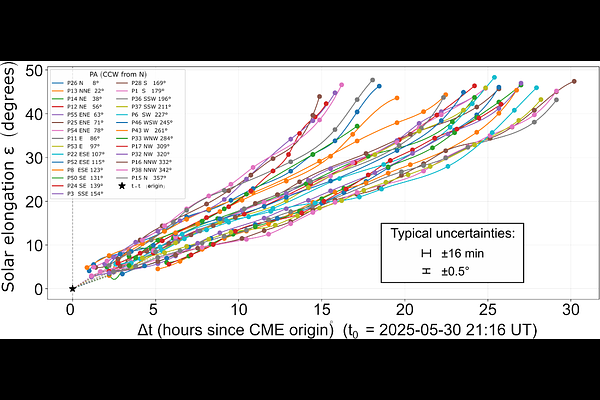
AbstractWe tracked the large, geoeffective halo coronal mass ejection (CME) of 2025-May-31 across the very wide field of view of the Polarimeter to Unify the Corona and Heliosphere (PUNCH) mission, as a proof of concept for data-informed forecasting of CME arrival times at Earth. using simple point-and-click measurement of the front location as far as 47 degrees away from the Sun itself, we constrained an analytic "ludicrous ice-cream cone" geometric model with just three parameters: position angle, off-Earth-Sun angle, and propagation speed. We show that the model is sufficient to capture the bulk envelope of the CME, and also insufficient to capture the complexity of the CME's evolution. We generated simulated arrival-time forecasts for the CME by extrapolating the constant-velocity propagation to determine the time of impact with Earth. These "retro-forecasts" converged to within 30 +/- 15 minutes of the actual arrival time, 8 hours prior to arrival. The convergence was marked by a clear inflection point in the curve of predicted-arrival-time vs time-of-forecast. We conclude that continuous wide-field tracking is sufficiently powerful to enable even crude models to substantially improve arrival-time forecasting precision, and discuss future work required both to validate this single-event result and to extend it to more sophisticated analyses.