Between Plateaus and Slopes: A Data-Driven Exploration of Spectral Diversity Across Type IIP/L Supernovae

Between Plateaus and Slopes: A Data-Driven Exploration of Spectral Diversity Across Type IIP/L Supernovae
Géza Csörnyei, Claudia P. Gutiérrez
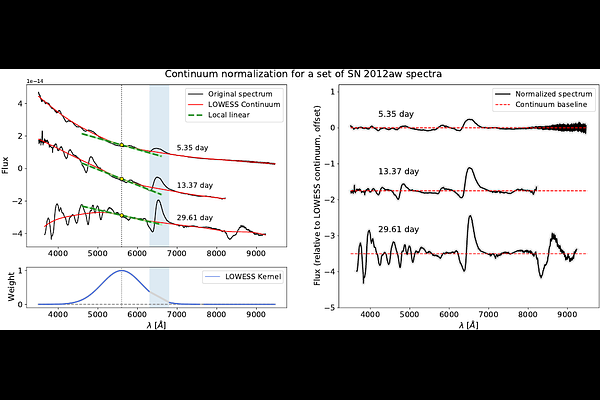
AbstractType II supernovae (SNe II) have been traditionally separated into several subgroups based on their photometric and spectroscopic properties, but whether these represent distinct progenitors or a continuous distribution remains debated. Over the past decade, growing observational evidence has suggested a possible continuity between slow- (IIP) and fast-declining (IIL) SNe. We investigate the continuity of the SNe IIP/L subclasses through a data-driven statistical analysis of spectral time series, aiming to determine whether significant correlations exist between overall spectral shapes and light-curve decline rates. We introduce a novel standardization method for SN II spectra. After empirically flattening the spectra via continuum normalization, we interpolate the resulting "feature spectra" onto a fixed grid of epochs using Gaussian Process regression. The interpolated spectra are then analyzed using Principal Component Analysis to explore correlations. We find that SNe IIP and IIL form a continuum spectroscopically, though some clustering remains. The spectral diversity is characterized mainly by two components: one continuous group with well-defined P-Cygni profiles and another with "less-regular" features likely driven by enhanced circumstellar material (CSM) interaction. Our results reveal that the spectral diversity of SNe IIP/L diminishes over time. We confirm observational correlations: steeper light-curve declines correspond to weaker spectral features, indicating that SNe IIL tend to show weaker emission and, in some cases, a lack of distinct absorption lines. These trends seemingly break down by enhanced CSM interaction that affects the P-Cygni profiles. Our data-driven method reveals underlying spectral correlations and supports a continuous distribution between IIP and IIL subtypes. This method paves the way for more refined classification algorithms.