Accurate Extragalactic Magnetic Fields from Faraday Rotation with Optimal Dispersion Measure Estimators

Accurate Extragalactic Magnetic Fields from Faraday Rotation with Optimal Dispersion Measure Estimators
Hilay Shah, Mark Krumholz, Naomi McClure-Griffiths, Zipeng Hu
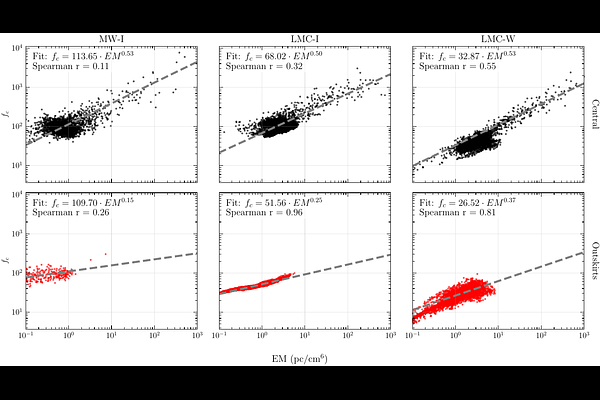
AbstractFaraday rotation measures (RMs) are one of our few observational tools for measuring magnetic field strengths in extragalactic systems, but converting an RM to a magnetic field estimate requires knowledge of the electron column density -- the dispersion measure (DM) -- to the RM source. Because DMs are difficult to measure for most extragalactic radio galaxies, observers have adopted a range of strategies to estimate them from more easily measured quantities, but the accuracy of these approaches is poorly known. To address this, we carry out simulated observations of high-resolution magnetohydrodynamic simulations of a range of galactic environments to explore the performance of various possible DM estimators. We obtain the best results using an estimator $\mathrm{DM} \propto \mathrm{EM}^α \ N_\mathrm{Hi}^β$, where EM is the emission measure and $N_\mathrm{Hi}$ is the atomic hydrogen column density, with exponents $α\approx 0.2-0.4$ and $β\approx 0-0.1$ depending on galactic environment (e.g., galaxy centres versus outskirts, and dwarfs versus spirals). We show that the variation of these exponents with environment can be understood in terms of simple physical arguments. Based on our tests, we provide recommended best practices for extracting galactic magnetic fields from RM data as a function of galactic environment and of proxy data availability, and show that using these methods one can obtain field measurements that are accurate to a few tenths of a dex. This work therefore represents an important step toward making use of RM data from next-generation surveys with the SKA.