Long-Term Radio Evolution of the Type Ia Supernova SN 2020eyj: Evidence for a Dense Helium-rich Circumstellar Shell

Long-Term Radio Evolution of the Type Ia Supernova SN 2020eyj: Evidence for a Dense Helium-rich Circumstellar Shell
Zheng-Wei Liu, Xiaolong Yang, Huanyuan Shan, Xuefei Chen, Peng Jiang, Xiangcun Meng, Friedrich K. Roepke, Ryotaro Chiba, Jun Yang, Bo Zhang, Su Yao, Jingxiao Luo, Philipp Podsiadlowski, Liang-Duan Liu, Hailiang Chen, Shuai Zha, Wu Jiang, Rurong Chen, Jin-Tao Luo, De Wu, Lang Cui, Jiao Li, Xiang-Dong Li, Ye Li, Zhanwen Han
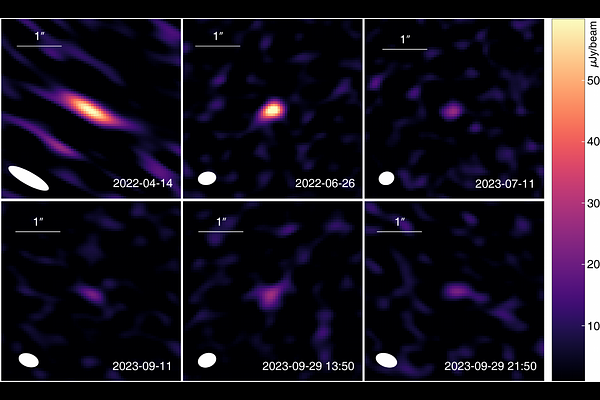
AbstractThe nature of progenitor systems of Type Ia supernovae (SNe Ia) and their explosion mechanism remain controversial. Radio observations provide a powerful probe of the interaction between SN ejecta and circumstellar material (CSM), offering important constraints on the mass-loss histories of their progenitor systems. We present extensive Jansky Very Large Array (JVLA) observations of SN 2020eyj at 1.5-10 GHz, tracing its radio emission to approximately 1300 days after discovery and revealing, for the first time, the long-term radio evolution of an SN Ia. The radio light curves of SN 2020eyj exhibit a relatively flat evolution at early epochs, followed by a gradual long-term decline, while its radio spectra show a power-law behavior with a low-frequency turnover. These characteristics appear to be consistent with synchrotron emission associated with shock interaction. Modeling the radio light curves favors a thick circumstellar shell with an inferred mass of approximately 0.3-0.4 solar masses over the simple wind-like configurations. Combined with the optical spectral signatures of SN 2020eyj, our radio observations provide strong evidence for substantial helium-rich mass loss from the progenitor system prior to explosion. The inferred CSM properties pose significant challenges to existing SN Ia progenitor models, although the ejection of a common envelope shortly before explosion may offer a plausible explanation.