What you see is not necessarily what you get: Interpreting near-infrared scattering phase functions of debris discs

What you see is not necessarily what you get: Interpreting near-infrared scattering phase functions of debris discs
Quincy Bosschaart, Johan Olofsson
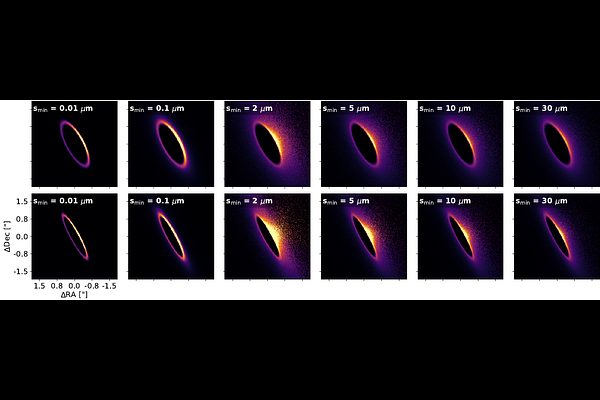
AbstractScattering phase functions (SPFs) derived from resolved scattered-light images of debris discs are widely used to infer dust grain properties, often via parametric forms such as the Henyey-Greenstein (HG) phase function. However, it remains unclear to what extent the inferred scattering behaviour reflects intrinsic dust properties rather than projection effects, disc geometry, or methodological choices. We test how reliably SPFs and HG asymmetry parameters can be recovered from scattered-light images and identify regimes where geometric and observational effects introduce significant biases. We use a physically motivated forward-modelling framework combining dust-scattering calculations, grain dynamics, and ray-tracing to generate synthetic total-intensity images. Since the intrinsic SPFs are known a priori, phase functions extracted from the images can be directly compared to the input scattering behaviour. We explore a grid of grain size distributions, disc inclinations, and opening angles, and fit two-component HG functions to evaluate how well the forward-scattering parameter $g_{1}$ traces grain properties. Even under idealised conditions with perfect knowledge of disc geometry, the recovered phase functions can differ substantially from the intrinsic SPFs. Limited scattering-angle coverage is the dominant effect: strong forward-scattering peaks at small angles are typically unobservable, leading to non-monotonic trends of apparent anisotropy with grain size. Projection effects, line-of-sight mixing, and SPF-extraction choices further modify the recovered phase functions, causing the fitted $g_{1}$ to depend strongly on viewing geometry and methodology. We conclude that SPFs and HG parameters derived from scattered-light images should be interpreted as effective, observation-dependent quantities rather than direct proxies for dust properties.