Expansion kinematics of young clusters. III. The kiloparsec sample

Expansion kinematics of young clusters. III. The kiloparsec sample
Joseph J. Armstrong, Jonathan C. Tan
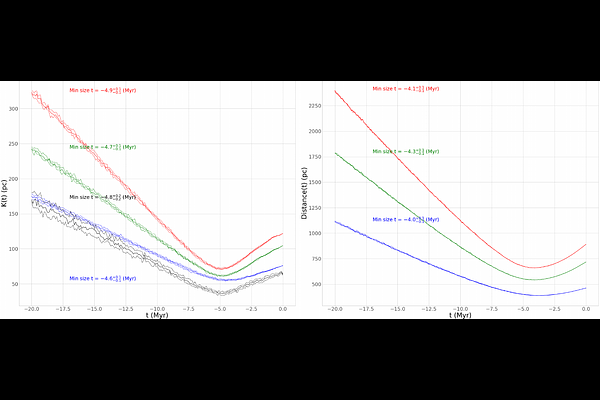
AbstractWe combine Gaia DR3 5-parameter astrometry with calibrated radial velocities for 23 nearby (<1 kpc) young (<60 Myr) clusters, with membership lists from Cantat-Gaudin et al. (2020). We characterise the plane-of-sky structure of the clusters using Q-Parameter and Angular Dispersion Parameter (ADP) methods. We measure plane-of-sky expansion using several methods. We determine plane-of-sky orientations along which expansion is maximised. We also estimate expansion timescales and traceback ages and compare to isochronal ages. We then look for correlations between cluster properties and discuss sample-wide trends. We find that most young clusters are more smoothly structured in their centers where the rate of dynamical interactions is highest, while hierarchical structure can survive in the sparse outskirts for >10 Myr. We also find that the majority of nearby young clusters exhibit clear signatures of expansion in the plane-of-sky, which in many cases is significantly anisotropic, even at ages >30 Myr. We find evidence that older clusters tend to have directions of maximum expansion oriented closer to parallel with the Galactic plane. The high degree of spatial structure and significant expansion anisotropy imply that the majority of these young clusters have formed with significant spatial and kinematic substructure and not as dense, monolithic clusters. Kinematic ages estimated from expansion timescales and on-sky traceback are generally in good agreement with estimates inferred from stellar evolution models for clusters <10 Myr old. However, many clusters with older isochronal ages appear to have significantly younger kinematic ages. We discuss potential reasons for this discrepancy, including a prolonged embedded and/or gravitationally bound phase in the early stages of the clusters.