Multi-Messenger Modeling of Low-Luminosity Gamma-Ray Bursts

Multi-Messenger Modeling of Low-Luminosity Gamma-Ray Bursts
Shiqi Yu, Bing Theodore Zhang
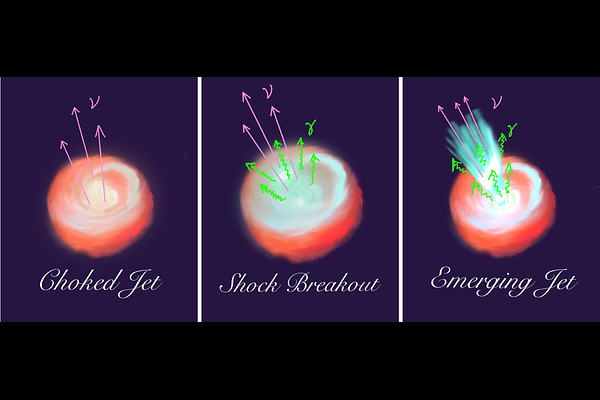
AbstractLow-luminosity gamma-ray bursts (LL GRBs), a subclass of the most powerful transients in the Universe, remain promising sources of high-energy astrophysical neutrinos, despite strong IceCube constraints on typical long GRBs. In this work, a novel approach is introduced to study a sample of seven LL~GRBs with their multi-wavelength observations to investigate leptohadronic processes during their prompt emission phases. The relative energy densities in magnetic fields, non-thermal electrons, and protons are constrained, with the latter defining the cosmic-ray (CR) loading factor. Our results suggest that LL~GRBs exhibit diverse emission processes, as confirmed by a machine-learning analysis of the fitted parameters. Across the seven LL~GRBs, we find the posterior medians of the CR loading factor in the range of $ξ_p \sim 0.2$--$1.6$. GRB~060218 and GRB~100316D, the lowest-luminosity bursts ($L_{γ, \rm iso} \sim 10^{46}$-$10^{47}\rm~erg~s^{-1}$) consistent with the shock-breakout (SBO) scenario, yield the highest CR loading factor and therefore are expected to produce neutrinos more efficiently. Our model predicts the expected number of neutrino signals that are consistent with current limits but would be detectable with next-generation neutrino observatories. These results strengthen the case for LL~GRBs as promising sources of high-energy astrophysical neutrinos and motivate real-time searches for coincident LL~GRB and neutrino events. Next-generation X-ray and MeV facilities will be critical for identifying more LL~GRBs and strengthening their role in multi-messenger astrophysics.