A Template-Based Search for Large-Scale-Structure--Correlated Anisotropy in the Nanohertz Gravitational-Wave Background Using the Public NANOGrav 15-Year Data Set

A Template-Based Search for Large-Scale-Structure--Correlated Anisotropy in the Nanohertz Gravitational-Wave Background Using the Public NANOGrav 15-Year Data Set
Yun Fang
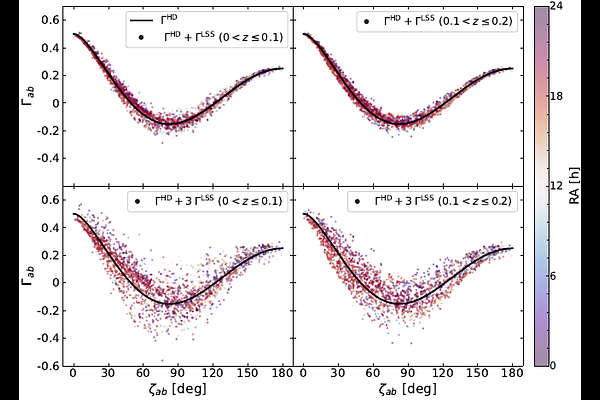
AbstractRecent PTA analyses reporting evidence for a nanohertz common-spectrum process motivate targeted tests of whether any anisotropic component of the stochastic gravitational-wave background (SGWB) is correlated with the nearby large-scale structure (LSS), as anticipated for an astrophysical background dominated by supermassive black hole binaries. We present the first Bayesian PTA likelihood analysis that embeds an externally observed, full-sky galaxy-survey LSS template directly as an overlap-reduction-function (ORF) component. Using the 2MASS Photometric Redshift (2MPZ) galaxy catalog, we construct low-multipole LSS--correlated ORF templates in two redshift slices ($0<z\le0.1$ and $0.1<z\le0.2$) and model PTA cross-correlations as $Γ_{ab}=Γ^{\rm HD}_{ab}+\sum_i ε_i\,Γ^{\rm LSS(i)}_{ab}$, where $ε_i$ quantifies the amplitude of an SGWB component whose angular correlations project onto the fixed 2MPZ LSS templates. Applying this framework to the NANOGrav 15-year dataset, we find no statistically significant evidence for an LSS-correlated component: $ε_i$ is consistent with zero in both single-bin and two-bin analyses (e.g., $ε_1=0.20^{+1.68}_{-1.66}$ and $ε_2=-0.11^{+2.04}_{-1.83}$; 68\% credible intervals), and Bayes factors favor the isotropic Hellings--Downs hypothesis ($\mathcal{B}_{{\rm HD+LSS}_1,{\rm HD}}=0.40$, $\mathcal{B}_{{\rm HD+LSS}_2,{\rm HD}}=0.43$, $\mathcal{B}_{{\rm HD+LSS}_{1+2},{\rm HD}}=0.11$). We therefore place upper limits on any 2MPZ-traced, LSS-correlated contribution to the SGWB at $z<0.2$. More broadly, our framework provides a reproducible pathway for incorporating observed LSS information into PTA anisotropy searches and naturally motivates extensions to finer redshift tomography and next-generation PTA datasets.