Star-planet magnetic interactions in photoevaporating exoplanets

Star-planet magnetic interactions in photoevaporating exoplanets
Andrés Presa, Aline A. Vidotto, Filip Elekes
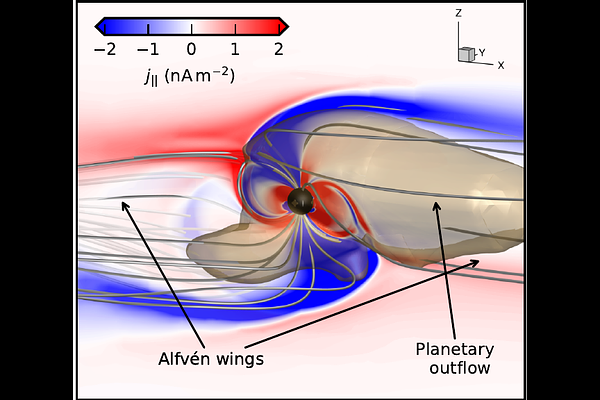
AbstractObservations of periodic stellar activity near the transit phase of a close-in exoplanet provide evidence of star-planet magnetic interactions (SPMI), similar to the magnetic coupling between Jupiter and its moons. Comparing the power associated with SPMI signals to analytical theories offers a way to constrain exoplanetary magnetic fields, but models based on moon-magnetosphere analogs often underpredict observed energy fluxes. Unlike moons, many close-in exoplanets are extended, highly irradiated gas giants undergoing significant photoevaporation. However, it is not known how atmospheric escape influences the star-planet magnetic coupling. Here, we present three-dimensional radiation magneto-hydrodynamic simulations that simultaneously model planetary evaporation and SPMI in a hot Jupiter planet embedded in a magnetised stellar wind. Our simulations reveal the formation of magnetic structures known as Alfvén wings, which transport magnetic energy away from the planet. When the dayside mass-loss rate $\dot{M}_d$ of the planet lies below a threshold $\dot{M}_0$ defined by pressure balance between the planetary and stellar winds ($\dot{M}_d \leq \dot{M}_0$), the maximal power delivered to the star matches predictions from the Alfvén wing model. For higher escape rates, the planetary outflow opens additional magnetic flux, and the SPMI power increases proportionally with $(\dot{M}_d / \dot{M}_0)^{1/2}$. Applying this scaling law to the HD18973 system, we find that a $30$ G planet could reproduce the observed power if $\dot{M}_d \sim 10^{12}$ g/s. Although this signal likely represents only a fraction of the total power, additional mechanisms could amplify the energy budget. These results show that photoevaporating exoplanets in sub-Alfvénic orbits constitute promising targets for SPMI observations.