Substructure in externally irradiated protoplanetary disks, I. spirals and rings in two-dimensional radiation hydrodynamics

Substructure in externally irradiated protoplanetary disks, I. spirals and rings in two-dimensional radiation hydrodynamics
Alexandros Ziampras, Lin Qiao, Thomas J. Haworth
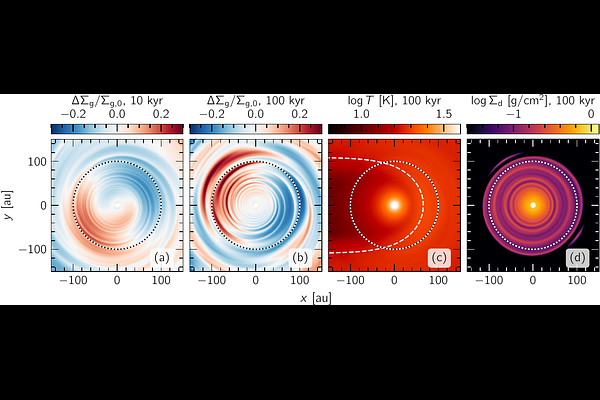
AbstractIt is known that the external irradiation of protoplanetary disks by nearby massive stars can result in mass loss that impacts the disk evolution, however the dynamical impact of external irradiation upon the disk itself has not been explored in detail. We aim to investigate the dynamical effect of asymmetric external irradiation on the structure of such disks. We perform two-dimensional multi-fluid radiation hydrodynamical simulations of protoplanetary disks subject to external irradiation using the PLUTO code, with external irradiation modeled as a plane-parallel flux and a simplified nonaxisymmetric heating rate corresponding to the thermal reemission from hot material within the region marginally optically thick to the external irradiation. We find that a nearby massive star can, under certain conditions, induce significant dynamical effects on a protoplanetary disk, including a shadowed region, pronounced spiral arms in gas, and rings and gaps in dust. The dynamics are caused by the temperature asymmetry driven and maintained by external irradiation, akin to the well-established mechanism of shadow-induced spirals and rings in disk with shadowing from their inner regions. Our results show that if an external temperature asymmetry can be induced it can have a significant dynamical impact on the disk itself (in addition to the well-studied mass loss and truncation effects due to external irradiation), possibly even driving substructure. This prompts further investigation with detailed, dynamical radiative transfer models.