Correlated residuals in Tully-Fisher and Fundamental Plane relations and their impact on peculiar velocity measurements

Correlated residuals in Tully-Fisher and Fundamental Plane relations and their impact on peculiar velocity measurements
Tyann Dumerchat, Raul E. Angulo, Julian Bautista, Cesar Aguayo, Sownak Bose, Lars Hernquist
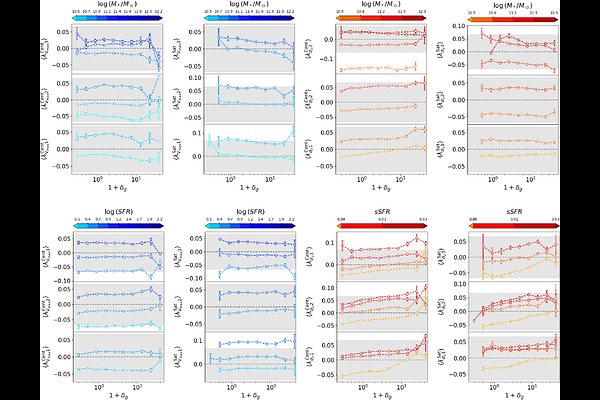
AbstractThe Tully-Fisher (TF) and Fundamental Plane (FP) relations are widely used to infer extragalactic distances and peculiar velocities, enabling measurements of large-scale velocity statistics and cosmological parameters. Using the Millennium-TNG hydrodynamical simulation, we assess the accuracy of these methods in the presence of realistic galaxy formation physics. We find that, while the 2-point statistics of velocities are reliably inferred on scales larger than $\sim10\,\hMpc$, significant systematic deviations arise on smaller scales. These deviations originate from spatially correlated residuals in the TF and FP relations, driven by correlations between galaxy structural properties, star-formation history, and the local environment. As a result, TF- and FP-inferred velocity fields exhibit spurious correlations with the galaxy density field that cannot be explained by random scatter alone. We show that extending the TF and FP relations to include additional galaxy properties -- such as star formation rate, gas mass, and stellar mass -- mitigate these environmental correlations, particularly for late-type galaxies. Our results demonstrate that galaxy formation physics induces significant systematics in peculiar velocity measurements on non-linear scales, and that neglecting these effects may bias cosmological analyses.