NGTS-39 b: A 58 d transiting warm Jupiter in an eccentric orbit

NGTS-39 b: A 58 d transiting warm Jupiter in an eccentric orbit
Ioannis Apergis, Daniel Bayliss, Solène Ulmer-Moll, Samuel Gill, Toby Rodel, Matthew Battley, Paul Benni, Allyson Bieryla, James A. Blake, Andrea Bonfanti, François Bouchy, Edward M. Bryant, Matthew R. Burleigh, Samuel J. Carlier, Sarah L. Casewell, Hritam Chakraborty, Alastair B. Claringbold, Karen A. Collins, Benjamin D. R. Davies, Xavier Dumusque, Troy A. Edkins, Fintan Eeles-Nolle, Jo Ann Egger, Jorge Fernández Fernández, Marcelo Aron Fetzner Keniger, Pedro Figueira, Michael R. Goad, George Harvey, Faith Hawthorn, Melissa J. Hobson, Mathilde Houelle, Giovanni Isopi, Timour Jestin, Alicia Kendall, Monika Lendl, Daniel Lewis, Isobel Lockley, Franco Mallia, James McCormac, Morgan A. Mitchell, Lucile Mignon, Hugh Osborn, Angelica Psaridi, Alex Romanec, Suman Saha, Amber Sedgley, Sérgio Sousa, Neil Thomas, Stéphane Udry, Christopher Watson, Richard G. West, Thomas G. Wilson, Peter J. Wheatley, Jamie T. Williams, Aldo Zapparata, Krzysztof Sz. Zieliński
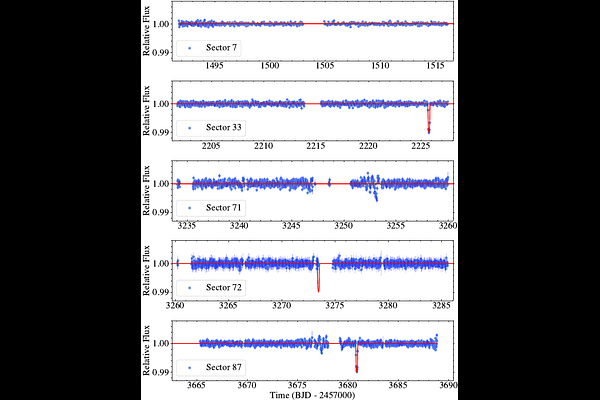
AbstractWe report the discovery and characterisation of NGTS-39 b (TIC 453147896 b), a warm Jupiter transiting a Sun-like star on a 58.2 day, eccentric (e = 0.386 +/- 0.019) orbit. NGTS-39 b was first identified from a TESS single-transit event, and subsequently confirmed with NGTS photometry and radial-velocity measurements from CORALIE and HARPS. The host star is a bright (Tmag = 11.02) F9 dwarf with an effective temperature of Teff = 6053 +67/-30 K. NGTS-39 b is a Jupiter-sized gas giant with a radius of 1.088 +/- 0.012 RJ and a mass of 1.467 +/- 0.081 MJ. Its equilibrium temperature is 519 +6/-5 K, placing it between short-period hot Jupiters and cold, Jupiter-like giants. The high orbital eccentricity and intermediate equilibrium temperature of NGTS-39 b make it a valuable test case for formation and migration models, particularly in the poorly sampled regime of long-period gas giants. The RV data show a linear trend of gamma dot = -17.75 m s^-1 yr^-1, which indicates the presence of an outer companion. The discovery of NGTS-39 b contributes to the small but growing population of transiting warm Jupiters with P > 50 days orbiting bright stars.